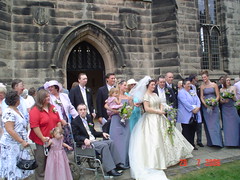
Cheadle Parish Church
Monday, July 31, 2006


Book Meme
From http://alastair.adversaria.co.uk/ comes a book meme:—
1. One book that changed your life:Promise and Deliverance, de Graff.
2. One book that you’ve read more than once:The Holy Spirit, Kuyper
3. One book you’d want on a desert island:The Bible
4. One book that made you laugh:1066 and All That
5. One book that made you cry:Pride and Perjury, Jonathan Aitken
6. One book that you wish had been written:My Life and Times, Oliver Cromwell
7. One book that you wish had never been written:The Koran
8. One book you’re currently reading:The Letters of Samuel Rutherford
9. One book you’ve been meaning to read:Silly question. If I mean to read one, I will.
10. Now tag five people: I do not have the technical knowledge to do this without wasting time.
1. One book that changed your life:Promise and Deliverance, de Graff.
2. One book that you’ve read more than once:The Holy Spirit, Kuyper
3. One book you’d want on a desert island:The Bible
4. One book that made you laugh:1066 and All That
5. One book that made you cry:Pride and Perjury, Jonathan Aitken
6. One book that you wish had been written:My Life and Times, Oliver Cromwell
7. One book that you wish had never been written:The Koran
8. One book you’re currently reading:The Letters of Samuel Rutherford
9. One book you’ve been meaning to read:Silly question. If I mean to read one, I will.
10. Now tag five people: I do not have the technical knowledge to do this without wasting time.
Saturday, July 29, 2006
Books read in July 2006 (15)
1. They F*** You Up: How to Survive Family Lifeby Oliver James
The title comes from Larkin but the author tells us he has not followed the misogynist's advice of not having any kids himself. He does though believe that most of our problems in life come from dysfunctional nurture, not genetics. This is an encouraging message because it means we are all responsible beings who can work to reflect on the past and correct what is wrong.
There seems to be a lot of Freudian psychology here. I do not buy a lot of his analysis as it is full of generalisation. He says there are three conscience types then tells us one may have parts of more than one of them. My major criticism is that this is a totally secular approach devoid of any objective standards of morality by which counsellees may be told some conduct is morally wrong, not merely destructive.Hhe seems to assume we all will have multiple sexual partners. He is denigratory of Christian child rearing which will use corporal punishment. He offers practical advice on how to audit one's past and chance for a better future but I did not find any of his stuff personally applicable. I had a good upbringing by loving parents in a stable marriage. So did my wife and so have our children. All parents are dysfunctional but this book seems address to those with more dysfunction than some of us have experienced.Hhe does have fascinating insights into some famous personalities and I am left with a lot of sympathy for our heir to the throne. There is good information here on a lot of mental health problems.
2. Calvin: For Armchair Theologians by Christopher Elwood
The style is Calvin for Dummies but I guess such a title might breach Dummies' copywrite. This book is well written at a popular level and has delightful cartoons. The history, thought and theology of the great French reformer of Geneva are sympathetically related. Calvin is absolved of some of the many slanders by his detractors, though not that of having a very vehement forceful character. It would also have helped to have been informed that Calvin was not even a citizen of Geneva for most of his stay there let alone its demagogue. The inheritors of Calvin are fairly described though there are some glaring omissions like Cromwell, Covenanters and the Kuyperian tradition. The is one little niggle, a commitment to inclusive language, so using third person feminine pronouns where the masculine is usual. But I wholeheartedly recommend this as an introduction to Calvin.
3. Our Culture, What's Left of It: The Mandarins and the Masses by Theodore Dalrymple
Dalrymple has worked as a prison and hospital doctor in an English city with sizeable minority communities. He is also widely travelled. most of these articles were published in an American journal. Is a prophet still withour honour inhis own country?
The first part is twelve literary and artistic reviews, Great on Shakespeare and Gilray, scathing of most moderns, especially for what passes as art but sometimes is literally, shit. My only criticism here is that he has the popular misconception of Puritans as killjoys and Calvin as a theocratic despot, both views far from reality.
Fourteen more essays are on culture and politics. The welfare state has produced an underclass unable to help themselves out of dependency on a state which encourages dependency , Sexual license, irresponsibility, political correctness and the folly of multi-culturalism. The article on Italian corruption is a surprise. The idol of Dianna is toppled.Drugs must be kept under control. and sex put back under restraint. Honeyford is applauded as a prophet. The author like the Bradford schoolmaster sees Islam in need of change but I fear he is too optimistic on that account. One only has to read his next chapter on France. The horror of the Wests is recounted. All that is missing is his reflections on Shipman and some prescription for a better future. Fascinating but in general a pessimistic book.
4. Muslims and the State in Britain, France, and Germany (Cambridge Studies in Social Theory, Religion & Politics)
by Joel S. Fetzer & J Christopher Soper
Two academics in the USA have produced this study surveying the relationship of Muslims to the state in three European countries. They look at how these countries, England (and it is England only in the study not all the U.K.), France and Germany have accommodated Muslim practices since the huge growth in immigrant Muslim populations in the last 50 years. Particular attention is paid to religion in state schools and to mosque building. Their conclusion is that Muslims have been given more freedom to publicly express their faith in England where the Church of England is the established religion, than is the case in the other two countries. In France, strict state secularism has even banned Muslim dress in state schools. Germany is between the two. There Muslims would like the same state financing as the major churches enjoy.
This book is very limited in its scope.What is very evident but never discussed here is that with Islam, freedom of religion is very much a one way street. Muslims in the West rightly use all possible means to freely practice their faith in a way that Christians in Muslim countries simply cannot do. Also ignored is the loyalty question, Are European Muslims primarily loyal to the nation state or to the Muslim umma. There is no mention of Islamic aim to establish their way of life as that of all society.
This book is very academic and not a gripping read. One niggle, England is not theoretically Christian. Constitutionally it is Anglican. In reality, it is secular but with a more benign approach to faith than the French, laicite.
5. The Dragons of Expectation: Reality and Delusion in the Course of History by Robert Conquest
Conquest is an expert on Russia and Communism in the last century. His book is mainly written against those who are the leftist fellow travellers who have still not accepted the truth about the evils perpetrated by totalitarians in the last century. I did not find this an easy read. Conquest is an intellectual who warns well against the statism of the West, the growing centalisation of government and the ever expanding beaurocracies. His critique of the undemocratic E.U. is particularly astute.
6. A Throne in Brussels: Britain, the Saxe-Coburgs and the Belgianisation of Europe by Paul Belien
Paul Belien has written a fascinating account of how the Coburgs went from an impoverished dukedom to be the monarchs of four European countries. They still rule Belgium where the king has more power than any other European monarch. All the Coburg males, with one exception, Baudouin, have beem more goat than man as far as their promiscuity is concerned. One of the worst was Queen Victora's beloved Uncle Leoplod, who we are told was probably the real father of Albert as well as a paedophile. Had not Leopold's wife, the Hanoverian Princess Charlotte, died in childbirth, Leopold would have been prince consort, not Albert. One can be thankful he became king of the newly created Belgium instead. Belien gives a full history of this artificial country with perpetual tension between Flemings and Walloons, Dutch and French speakers. The account of Leopold II and his personal possession, the Belgian Congo, is horrific. Leopold III betrayed his country and surrendered to Hitler. Amazingly the Belgians voted to have him back afterwards. All the Coburg kings except Baudouin have not been servants of their countries but exploiters for personal enrichment. Belien sees the way Belgium is kept together and run to be a prototype for the E.U. superstate. Read this and be warned. At least I do not think a federal Europe would have a Coburg for king.
7. The West's Last Chance: Winning the Clash of Civilization by Tony Blankley
Blankley starts his book with a gripping nightmare scenario of Europe giving in the the demands of Islamists so precipitating a rift with the USA. he wants the US to declare war on the Islamists. This is a book written by and for the American right. Moderate Muslims are distinguished from Islamists but the writer does not seem to involve them in dealing with their more extreme co-religionists. This is to me the major weakness of his thinking. Surely only Muslims can really work on the root of this problem, A violent section of Islam that has a long pedigree. I do not want to see Eurabis but can the US really declare war on Islamism when it cannot even get Muslims on board to support its action in Iraq? I agree our security forces should use ethnic profiling and they should secure our borders. I would totally oppose his idea of identification cards for all. That is to make the law abiding pay a tax on terrorism. I agree the war against multiculturalism in Europe must be won with a return to pride in our Christian heritage which has given us pluralism. This is an easy read, a popular style, but lacks depth and engagement with Muslims.
8. Western Muslims and the Future of Islam by Tariq Ramadan
The author has been describe as a Muslim Martin Luther. That is an exaggeration as neither the secular nor the religious powers of the day are seeking his life as far as I know. But like Luther, Ramadan is a reformer who says that Muslims must adapt to be citizens in democratic countries in the West. He divides Muslims into five groupings and he seems closest to liberal or rational Reformism. He wants Muslims to adapt and engage with Western culture and the political process. He does not believe in retreat to the ghetto nor in exclusively Muslim schools. Muslims can and should be good citizens in Western democracies. He rejects the traditional division of the world into abodes of Islam and of War. He says Muslims in the west are at liberty to practise and propagate their faith. I found much of what he discussed to be relevant to Christians who see their faith as a way of life not mere religion. The way of spirituality and being distinctive from the surrounding culture are common concerns. I regret he did not develop the idea of co-belligerent action in his chapter on dialogue. My other regret is that he says little or nothing about the origins of the violent strands of Islam which threaten us today. But this book is a positive start to better relations with Muslims in the West.
9. Puritanism and Revolution: Studies in Interpretation of the English Revolution of the Seventeenth Centuryby Christopher Hill
Hill is an expert on 17th century England and does not let one down. His perspective may be Marxist but he really does understand what made godly Puritans tick.This is a mixed bag of essays. The best are on the consequences of reformation, the Norman Yoke, Clarendon, Perkins and Preston. Here you learn the breadth of Puritan interests and what friends and enemies thought of them.
10. Tales of Two Cities: Christianity and Politics by Stephen Clark
These are papers on politics delivered at a conference of Affinity, formerly the separatist British Ecumenical Council. Anglicans presenting papers for Affinity shows they have moved from the hard line separatism of the former B.E.C. Wenham shows how Israel's law can be a paridigm for today. His paper is most memorable for his case for vegetarianism. Wilmshurst shows how Jesus was political though not primarily so. Storkey has given us a more comprehensive and exciting treatment of this in his recent book. Field is stimulating on Rutherford, especially on how Rutherford would have questioned things today. Helm is helpful distinguishing the varieties of pluralism today but I think he should have told of Kuyper's pluralism. Davis Smith gives an excellent paper on Miall, a Victorian dissenter too hot for the Free Church establishment of the day. I found McKay a little disappointing on the crown rights of King Jesus, Does not his own Covenanter tradition discourage contemporary political involvement bcause our government does not acknowledge the 17th century covenants? This is never mentioned. I also believe he uneccesarily besmirches Kuyper on race. In conclusion, Stephen Clark gives a helpful summary of some contemporary problems, but why not even a mention of having an explicitly Christian political party? Is Kuyper not only dead and buried but forgotten? There is much to enjoy and stimulate in this book but why in the age of computers is a scholarly work deprived of an index?
11. Not a Man to Match Her: Feminist View of Britain's First Woman Prime Minister by Wendy Webster
This is an interesting perspective on how the image of Margaret Thatcher was manipulated to promote her political career. The author contends that the early 1950s politician was all for women with children continuing with their careers as she did, but her later position was much more for the traditional role of women as mothers not careerists. Her major gripe is that Thatcher never did anything to promote women in politics. Of course the feminist position is that women should have been promoted into Thatcher's cabinet because they were women. Mrs Thatcher on the other hand seems to have preferred to promote on merit not gender.
While the author is no fan she can at times show admiration for the Iron Lady. But she seems to make no attempt to get at the real woman, telling us rather about the development of an image. The author portrays a self-centred woman.Oother biographers have written of a more personally caring Thatcher.
12. Pi in the High by Eric Lionel Mascall
Mascal was an Anglo-Catholic theologian. This short book of poetry requires a decent amount of theological knowledge for one to appreciate the wit and the parodies which are well written and illustrated. A delightful little read.
13. Masters of the English Reformation by Marcus Loane
First published in 1954 to mark the 400th anniversary of the executions of the Oxford martyrs, this book is a gem. One cannot but be thrilled to read of the developing faith of five godly men whose devotion to the truth led them to make the ultimate witness. One is also encouraged to see that these were men like us who sometimes failed. Bilney and Cranmer made recantations of their faith which they bitterly regretted.Bilney was one of the first to be converted to the reformed Faith. A Cambridge scholar he was famed for his witness and practical piety in visiting the poor and prisoners. The night before his execution he prepared for pain by burning toff the end of a finger in a candle flame. He led Latimer to Christ by asking to confess his sins to him. Latimer went on to become the greatest preacher of his age, a man Henry VIII would hear though Latimer trimmed nothing to suit the king. Ridley was the scholar who discovered that transubstantiation was not the doctrine taught by the church fathers. In this he greatly influenced Cranmer, the scholar who came to Henry's attention by his advice on the king's divorce.Cranmer was thus appointed to Archbishop of Canterbury over the heads of all the then bishops. Henry trusted him and protected him like no other man. Cranmer was bold with the king, pleading for mercy for Mary Tudor, Anne Bolyne, Thomas Cromwell and others. He is the man most responsible for England having a Reformed national church with incomparable liturgy. When Mary became queen he refused the advice of his friends to flee the land. He stayed to die.Tyndale fled England under Henry to give us the bible in our own tongue. His translation is the unackonwledged basis of the King James Bible. After a life moving from country to country, translating and publishing, he made his ultimate witness in Belgium.
14, The Oxford Dictionary of Humorous Quotations by Ned Sherrin
This topically arranged dictionary of quotations is more than a collection of humorous quotations. perhaps it should be titled, Sherrin's Favorite Quotes. For reference to sources it is not a patch on Nigel Rees.
15. Forever Today: A Memoir of Love and Amnesia by Deborah Wearing
Some factual books are of a kind that if they were fictional writings, they would be too strange to be believed. This is one of them. It is also that rare factual book, one that you cannot put down because you do not know how it will end and you are gripped by the narrative.
In his forties, Clive Wearing, an expert on ancient music was nearly killed by viral encephalitis. Not diagnosed for a week, he only survived because an anti-viral drug was eventually administered. But a lot of his brain was destroyed, especially the parts giving memory. His amnesia was the worst ever seen. Not all past memory was gone, but he had no capacity for new memories. He never knew how long he had been ill, never recognised people who cared for him professioanlly for years, could not remember food and drink previously taken. yet he could recognise family at times, read music not books, could write and could conduct a choir and play the organ. Initially euphoric, Clive then spent weeks in uncontrolled weeping when he realised something of his predicament. He could also be violent. To her horror, his wife Deborah, only in her twenties, found there were no facilites for ambulant brain damaged people like Clive. So, working in P.R., she was able to get a T.V. documentary made about him and start a charity which eventually led to the provision of specialist facilities to care for Clive. For six years had been in a psychiatric ward. With Clive settled, Deborah left England , divorced and hoped to find another man to give her children. But she came back to England, Clive and an amazing conversion to Christian faith which led to a renewal of marriage vows.
This is simply a spell binding story of tragedy and love. I have never read anything like it.
The title comes from Larkin but the author tells us he has not followed the misogynist's advice of not having any kids himself. He does though believe that most of our problems in life come from dysfunctional nurture, not genetics. This is an encouraging message because it means we are all responsible beings who can work to reflect on the past and correct what is wrong.
There seems to be a lot of Freudian psychology here. I do not buy a lot of his analysis as it is full of generalisation. He says there are three conscience types then tells us one may have parts of more than one of them. My major criticism is that this is a totally secular approach devoid of any objective standards of morality by which counsellees may be told some conduct is morally wrong, not merely destructive.Hhe seems to assume we all will have multiple sexual partners. He is denigratory of Christian child rearing which will use corporal punishment. He offers practical advice on how to audit one's past and chance for a better future but I did not find any of his stuff personally applicable. I had a good upbringing by loving parents in a stable marriage. So did my wife and so have our children. All parents are dysfunctional but this book seems address to those with more dysfunction than some of us have experienced.Hhe does have fascinating insights into some famous personalities and I am left with a lot of sympathy for our heir to the throne. There is good information here on a lot of mental health problems.
2. Calvin: For Armchair Theologians by Christopher Elwood
The style is Calvin for Dummies but I guess such a title might breach Dummies' copywrite. This book is well written at a popular level and has delightful cartoons. The history, thought and theology of the great French reformer of Geneva are sympathetically related. Calvin is absolved of some of the many slanders by his detractors, though not that of having a very vehement forceful character. It would also have helped to have been informed that Calvin was not even a citizen of Geneva for most of his stay there let alone its demagogue. The inheritors of Calvin are fairly described though there are some glaring omissions like Cromwell, Covenanters and the Kuyperian tradition. The is one little niggle, a commitment to inclusive language, so using third person feminine pronouns where the masculine is usual. But I wholeheartedly recommend this as an introduction to Calvin.
3. Our Culture, What's Left of It: The Mandarins and the Masses by Theodore Dalrymple
Dalrymple has worked as a prison and hospital doctor in an English city with sizeable minority communities. He is also widely travelled. most of these articles were published in an American journal. Is a prophet still withour honour inhis own country?
The first part is twelve literary and artistic reviews, Great on Shakespeare and Gilray, scathing of most moderns, especially for what passes as art but sometimes is literally, shit. My only criticism here is that he has the popular misconception of Puritans as killjoys and Calvin as a theocratic despot, both views far from reality.
Fourteen more essays are on culture and politics. The welfare state has produced an underclass unable to help themselves out of dependency on a state which encourages dependency , Sexual license, irresponsibility, political correctness and the folly of multi-culturalism. The article on Italian corruption is a surprise. The idol of Dianna is toppled.Drugs must be kept under control. and sex put back under restraint. Honeyford is applauded as a prophet. The author like the Bradford schoolmaster sees Islam in need of change but I fear he is too optimistic on that account. One only has to read his next chapter on France. The horror of the Wests is recounted. All that is missing is his reflections on Shipman and some prescription for a better future. Fascinating but in general a pessimistic book.
4. Muslims and the State in Britain, France, and Germany (Cambridge Studies in Social Theory, Religion & Politics)
by Joel S. Fetzer & J Christopher Soper
Two academics in the USA have produced this study surveying the relationship of Muslims to the state in three European countries. They look at how these countries, England (and it is England only in the study not all the U.K.), France and Germany have accommodated Muslim practices since the huge growth in immigrant Muslim populations in the last 50 years. Particular attention is paid to religion in state schools and to mosque building. Their conclusion is that Muslims have been given more freedom to publicly express their faith in England where the Church of England is the established religion, than is the case in the other two countries. In France, strict state secularism has even banned Muslim dress in state schools. Germany is between the two. There Muslims would like the same state financing as the major churches enjoy.
This book is very limited in its scope.What is very evident but never discussed here is that with Islam, freedom of religion is very much a one way street. Muslims in the West rightly use all possible means to freely practice their faith in a way that Christians in Muslim countries simply cannot do. Also ignored is the loyalty question, Are European Muslims primarily loyal to the nation state or to the Muslim umma. There is no mention of Islamic aim to establish their way of life as that of all society.
This book is very academic and not a gripping read. One niggle, England is not theoretically Christian. Constitutionally it is Anglican. In reality, it is secular but with a more benign approach to faith than the French, laicite.
5. The Dragons of Expectation: Reality and Delusion in the Course of History by Robert Conquest
Conquest is an expert on Russia and Communism in the last century. His book is mainly written against those who are the leftist fellow travellers who have still not accepted the truth about the evils perpetrated by totalitarians in the last century. I did not find this an easy read. Conquest is an intellectual who warns well against the statism of the West, the growing centalisation of government and the ever expanding beaurocracies. His critique of the undemocratic E.U. is particularly astute.
6. A Throne in Brussels: Britain, the Saxe-Coburgs and the Belgianisation of Europe by Paul Belien
Paul Belien has written a fascinating account of how the Coburgs went from an impoverished dukedom to be the monarchs of four European countries. They still rule Belgium where the king has more power than any other European monarch. All the Coburg males, with one exception, Baudouin, have beem more goat than man as far as their promiscuity is concerned. One of the worst was Queen Victora's beloved Uncle Leoplod, who we are told was probably the real father of Albert as well as a paedophile. Had not Leopold's wife, the Hanoverian Princess Charlotte, died in childbirth, Leopold would have been prince consort, not Albert. One can be thankful he became king of the newly created Belgium instead. Belien gives a full history of this artificial country with perpetual tension between Flemings and Walloons, Dutch and French speakers. The account of Leopold II and his personal possession, the Belgian Congo, is horrific. Leopold III betrayed his country and surrendered to Hitler. Amazingly the Belgians voted to have him back afterwards. All the Coburg kings except Baudouin have not been servants of their countries but exploiters for personal enrichment. Belien sees the way Belgium is kept together and run to be a prototype for the E.U. superstate. Read this and be warned. At least I do not think a federal Europe would have a Coburg for king.
7. The West's Last Chance: Winning the Clash of Civilization by Tony Blankley
Blankley starts his book with a gripping nightmare scenario of Europe giving in the the demands of Islamists so precipitating a rift with the USA. he wants the US to declare war on the Islamists. This is a book written by and for the American right. Moderate Muslims are distinguished from Islamists but the writer does not seem to involve them in dealing with their more extreme co-religionists. This is to me the major weakness of his thinking. Surely only Muslims can really work on the root of this problem, A violent section of Islam that has a long pedigree. I do not want to see Eurabis but can the US really declare war on Islamism when it cannot even get Muslims on board to support its action in Iraq? I agree our security forces should use ethnic profiling and they should secure our borders. I would totally oppose his idea of identification cards for all. That is to make the law abiding pay a tax on terrorism. I agree the war against multiculturalism in Europe must be won with a return to pride in our Christian heritage which has given us pluralism. This is an easy read, a popular style, but lacks depth and engagement with Muslims.
8. Western Muslims and the Future of Islam by Tariq Ramadan
The author has been describe as a Muslim Martin Luther. That is an exaggeration as neither the secular nor the religious powers of the day are seeking his life as far as I know. But like Luther, Ramadan is a reformer who says that Muslims must adapt to be citizens in democratic countries in the West. He divides Muslims into five groupings and he seems closest to liberal or rational Reformism. He wants Muslims to adapt and engage with Western culture and the political process. He does not believe in retreat to the ghetto nor in exclusively Muslim schools. Muslims can and should be good citizens in Western democracies. He rejects the traditional division of the world into abodes of Islam and of War. He says Muslims in the west are at liberty to practise and propagate their faith. I found much of what he discussed to be relevant to Christians who see their faith as a way of life not mere religion. The way of spirituality and being distinctive from the surrounding culture are common concerns. I regret he did not develop the idea of co-belligerent action in his chapter on dialogue. My other regret is that he says little or nothing about the origins of the violent strands of Islam which threaten us today. But this book is a positive start to better relations with Muslims in the West.
9. Puritanism and Revolution: Studies in Interpretation of the English Revolution of the Seventeenth Centuryby Christopher Hill
Hill is an expert on 17th century England and does not let one down. His perspective may be Marxist but he really does understand what made godly Puritans tick.This is a mixed bag of essays. The best are on the consequences of reformation, the Norman Yoke, Clarendon, Perkins and Preston. Here you learn the breadth of Puritan interests and what friends and enemies thought of them.
10. Tales of Two Cities: Christianity and Politics by Stephen Clark
These are papers on politics delivered at a conference of Affinity, formerly the separatist British Ecumenical Council. Anglicans presenting papers for Affinity shows they have moved from the hard line separatism of the former B.E.C. Wenham shows how Israel's law can be a paridigm for today. His paper is most memorable for his case for vegetarianism. Wilmshurst shows how Jesus was political though not primarily so. Storkey has given us a more comprehensive and exciting treatment of this in his recent book. Field is stimulating on Rutherford, especially on how Rutherford would have questioned things today. Helm is helpful distinguishing the varieties of pluralism today but I think he should have told of Kuyper's pluralism. Davis Smith gives an excellent paper on Miall, a Victorian dissenter too hot for the Free Church establishment of the day. I found McKay a little disappointing on the crown rights of King Jesus, Does not his own Covenanter tradition discourage contemporary political involvement bcause our government does not acknowledge the 17th century covenants? This is never mentioned. I also believe he uneccesarily besmirches Kuyper on race. In conclusion, Stephen Clark gives a helpful summary of some contemporary problems, but why not even a mention of having an explicitly Christian political party? Is Kuyper not only dead and buried but forgotten? There is much to enjoy and stimulate in this book but why in the age of computers is a scholarly work deprived of an index?
11. Not a Man to Match Her: Feminist View of Britain's First Woman Prime Minister by Wendy Webster
This is an interesting perspective on how the image of Margaret Thatcher was manipulated to promote her political career. The author contends that the early 1950s politician was all for women with children continuing with their careers as she did, but her later position was much more for the traditional role of women as mothers not careerists. Her major gripe is that Thatcher never did anything to promote women in politics. Of course the feminist position is that women should have been promoted into Thatcher's cabinet because they were women. Mrs Thatcher on the other hand seems to have preferred to promote on merit not gender.
While the author is no fan she can at times show admiration for the Iron Lady. But she seems to make no attempt to get at the real woman, telling us rather about the development of an image. The author portrays a self-centred woman.Oother biographers have written of a more personally caring Thatcher.
12. Pi in the High by Eric Lionel Mascall
Mascal was an Anglo-Catholic theologian. This short book of poetry requires a decent amount of theological knowledge for one to appreciate the wit and the parodies which are well written and illustrated. A delightful little read.
13. Masters of the English Reformation by Marcus Loane
First published in 1954 to mark the 400th anniversary of the executions of the Oxford martyrs, this book is a gem. One cannot but be thrilled to read of the developing faith of five godly men whose devotion to the truth led them to make the ultimate witness. One is also encouraged to see that these were men like us who sometimes failed. Bilney and Cranmer made recantations of their faith which they bitterly regretted.Bilney was one of the first to be converted to the reformed Faith. A Cambridge scholar he was famed for his witness and practical piety in visiting the poor and prisoners. The night before his execution he prepared for pain by burning toff the end of a finger in a candle flame. He led Latimer to Christ by asking to confess his sins to him. Latimer went on to become the greatest preacher of his age, a man Henry VIII would hear though Latimer trimmed nothing to suit the king. Ridley was the scholar who discovered that transubstantiation was not the doctrine taught by the church fathers. In this he greatly influenced Cranmer, the scholar who came to Henry's attention by his advice on the king's divorce.Cranmer was thus appointed to Archbishop of Canterbury over the heads of all the then bishops. Henry trusted him and protected him like no other man. Cranmer was bold with the king, pleading for mercy for Mary Tudor, Anne Bolyne, Thomas Cromwell and others. He is the man most responsible for England having a Reformed national church with incomparable liturgy. When Mary became queen he refused the advice of his friends to flee the land. He stayed to die.Tyndale fled England under Henry to give us the bible in our own tongue. His translation is the unackonwledged basis of the King James Bible. After a life moving from country to country, translating and publishing, he made his ultimate witness in Belgium.
14, The Oxford Dictionary of Humorous Quotations by Ned Sherrin
This topically arranged dictionary of quotations is more than a collection of humorous quotations. perhaps it should be titled, Sherrin's Favorite Quotes. For reference to sources it is not a patch on Nigel Rees.
15. Forever Today: A Memoir of Love and Amnesia by Deborah Wearing
Some factual books are of a kind that if they were fictional writings, they would be too strange to be believed. This is one of them. It is also that rare factual book, one that you cannot put down because you do not know how it will end and you are gripped by the narrative.
In his forties, Clive Wearing, an expert on ancient music was nearly killed by viral encephalitis. Not diagnosed for a week, he only survived because an anti-viral drug was eventually administered. But a lot of his brain was destroyed, especially the parts giving memory. His amnesia was the worst ever seen. Not all past memory was gone, but he had no capacity for new memories. He never knew how long he had been ill, never recognised people who cared for him professioanlly for years, could not remember food and drink previously taken. yet he could recognise family at times, read music not books, could write and could conduct a choir and play the organ. Initially euphoric, Clive then spent weeks in uncontrolled weeping when he realised something of his predicament. He could also be violent. To her horror, his wife Deborah, only in her twenties, found there were no facilites for ambulant brain damaged people like Clive. So, working in P.R., she was able to get a T.V. documentary made about him and start a charity which eventually led to the provision of specialist facilities to care for Clive. For six years had been in a psychiatric ward. With Clive settled, Deborah left England , divorced and hoped to find another man to give her children. But she came back to England, Clive and an amazing conversion to Christian faith which led to a renewal of marriage vows.
This is simply a spell binding story of tragedy and love. I have never read anything like it.
Wednesday, July 26, 2006
When you complain to the BBC
My complaint was,
The interview with the Danish man who published the Mohammed cartoons
was totally biased against the interviewee. One might have thought your
interviewer was a Muslim. She exhibited what is known as dhimmitude, the
acceptance of subservience to Islam by minority communities. The Danish
man, by contrast was exceedinly gracious in response. Usually one
complains of a liberal bias in BBC programmes. This one had a totally
Muslim bias. What happened to freedom of speech?
The reply,
Thanks for your comments. I'm sorry you didn't like this interview.
However, as the programme editor on this particular occasion I feel I
should defend Sarah. Unfortunately, we had far less time for this
interview by the time we got to it (at the end of an hour) than we had
intended or would have liked. This was very unfortunate, but something
that does happen from time to time with a live programme (other items
had over-run considerably). As a result, Sarah was forced to try to
cover a lot of ground quickly. I also think it's fair to say that
Fleming Rose tried quite hard to avoid answering the questions he was
being asked, which didn't help us. Overall, it wasn't a great result
for anyone, but I do think it unfair to blame Sarah for her part.
Best wishes, Matthew Grant, Today Programme.
Well, I do blame her for not defending freedom of speech. I am appalled that the media here and in the USA have given into the followers of the false prophet.
The interview with the Danish man who published the Mohammed cartoons
was totally biased against the interviewee. One might have thought your
interviewer was a Muslim. She exhibited what is known as dhimmitude, the
acceptance of subservience to Islam by minority communities. The Danish
man, by contrast was exceedinly gracious in response. Usually one
complains of a liberal bias in BBC programmes. This one had a totally
Muslim bias. What happened to freedom of speech?
The reply,
Thanks for your comments. I'm sorry you didn't like this interview.
However, as the programme editor on this particular occasion I feel I
should defend Sarah. Unfortunately, we had far less time for this
interview by the time we got to it (at the end of an hour) than we had
intended or would have liked. This was very unfortunate, but something
that does happen from time to time with a live programme (other items
had over-run considerably). As a result, Sarah was forced to try to
cover a lot of ground quickly. I also think it's fair to say that
Fleming Rose tried quite hard to avoid answering the questions he was
being asked, which didn't help us. Overall, it wasn't a great result
for anyone, but I do think it unfair to blame Sarah for her part.
Best wishes, Matthew Grant, Today Programme.
Well, I do blame her for not defending freedom of speech. I am appalled that the media here and in the USA have given into the followers of the false prophet.
Passing the cricket test
Some years ago Norman Tebbit was reviled for suggesting that most people from England's ethnic minorities failed the cricket test of loyalty to England. I think this is still the case. My friend born in Guyana joins me in supporting England except when the West Indies visit. As a Yorkshire supporter in London who am I to complain?
But one Sajid Mahmood from Bolton and Lancashire, having been selected for England, passes the test with flying colours. He has announced he will not let his father have a ticket if he is coming to the test to support Pakistan.
But one Sajid Mahmood from Bolton and Lancashire, having been selected for England, passes the test with flying colours. He has announced he will not let his father have a ticket if he is coming to the test to support Pakistan.
BBC Radio has no pride
I am nauseated by the radio coverage of the 50th anninxersary of the Suez debacle so I have written them as follows,
Am I alone in thinking your coverage is indicative of that Great British habit of glorifying defeat? Thanks to our perfidious allies, the USA, I remember Suez as a national humiliation. Where has national pride gone that you wallow in the memory of this sad event?
Graham Weeks
p.s. More fool me thinking the BBC should have any national pride.
I expect no positive resonse as it is par for the course for the left of centre liberals who gave us such debacles as The Dome. They had no pride in 2000 years of Christianity so filled it with multicultural mush.
Am I alone in thinking your coverage is indicative of that Great British habit of glorifying defeat? Thanks to our perfidious allies, the USA, I remember Suez as a national humiliation. Where has national pride gone that you wallow in the memory of this sad event?
Graham Weeks
p.s. More fool me thinking the BBC should have any national pride.
I expect no positive resonse as it is par for the course for the left of centre liberals who gave us such debacles as The Dome. They had no pride in 2000 years of Christianity so filled it with multicultural mush.
Tuesday, July 25, 2006
Middlesex v Sussex at Southgate
Sussex in the field, Middlesex batting to a draw, last day of a county match. Shortly after this the rain came for a second time so I retired home. Until lunch I was getting sunburned.

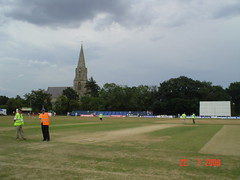
The Walker Ground, Southgate, Middlesex CCC.
Lords it is not but very pleasant. Here you can stroll on the ground at lunchtime, unlike Lors where the penalty could be £2,000 fine.
From the Southgate square
From the left, players' enclosure, pavilion with bar, Middlesex CCC tent and corporate hopitality tent viewed from across the wicket at lunchtime.
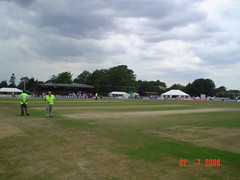
Bowler's view at Southgate
Bowler's view at Southgate - well if there were stumps and team in place.


Thursday, July 20, 2006
I am not a fan of the Emerging Church but .....
I found this at http://thecomplexchrist.typepad.com/the_complex_christ/2006/07/how_many_ec_blo.html and consider it a wothy addition to the light bulb tradition.
How many Emerging Church Bloggers Does it Take to Change a Light Bulb?
1 To change the bulb and post about it
315 To lurk around and make no comment
2 To propose a stack of del.icio.us tags the poster should have put in
16 To complain he should have used categories
4 To flag up a conference on nu-media emerging bulb ministries "The LED Shines in the 80% Greyscale-ness" in Ukraine.
19 To point out that if the poster had bought an iBulb then he wouldn't be in this mess in the first place.
4 To point out that it's 'Lightbulb', not 'Light Bulb'
7 To have go at those 4 for being so pathetic.
2 To come back and say they've had to pull out of the Ukraine conference, and the other 2 to post some blurred photos of a bunch of guys drinking beer in a dark room, Apple logos just visible in the shadows. Plus an inaudible podcast of the session they did.
5 To complain that the poster's definition of 'broken' was just liberal nonsense in the first place, and if they had only stuck to the One True Light, which is perfectly clearly explained in the Gospels then all talk of change would be irrelevant.
34 To retort that all talk of 'light' and 'dark' is just relative, and purely down to the culture, context and personal experience.
15 Fundies to rock in suggesting that the bulb was never broken, but rather the power had been switched off as punishment for their straying from the one true source.
2 Aging alt.worshippers to suggest they used tea-lights instead.
18 To weigh in with quotes from Derrida, Baumann and McLuhan and discuss the essential duality of light.
1 To raise the point that Don Carson hasn't needed 'artificial light' for many years, and refutes all physics suggesting light displays dualistic properties.
3 To complain of the lack of ethnic women changing light bulbs these days.
5 To raise the issue of 'wireless bulbs' that need no power source and can be used in Scooter Cafe.
2 To reflect on this as a model for mission, taking our wireless bulbs out into the dark world.
4 To continue this theme, but argue that the bulbs aren't really wireless, but part of a complex, distributed network of light sources of many different sorts, which interact in loose communal ways and that's what we call church now.
1 To write a huge long, rambling diatribe about the issue of light, how they suffered light deprivation as a child and are now trying to work this out in a small group in Andover, and completely kill the discussion, just leaving...
15 Online pharmacies, porn sites and penny-share stock companies to leave Trackbacks.
How many Emerging Church Bloggers Does it Take to Change a Light Bulb?
1 To change the bulb and post about it
315 To lurk around and make no comment
2 To propose a stack of del.icio.us tags the poster should have put in
16 To complain he should have used categories
4 To flag up a conference on nu-media emerging bulb ministries "The LED Shines in the 80% Greyscale-ness" in Ukraine.
19 To point out that if the poster had bought an iBulb then he wouldn't be in this mess in the first place.
4 To point out that it's 'Lightbulb', not 'Light Bulb'
7 To have go at those 4 for being so pathetic.
2 To come back and say they've had to pull out of the Ukraine conference, and the other 2 to post some blurred photos of a bunch of guys drinking beer in a dark room, Apple logos just visible in the shadows. Plus an inaudible podcast of the session they did.
5 To complain that the poster's definition of 'broken' was just liberal nonsense in the first place, and if they had only stuck to the One True Light, which is perfectly clearly explained in the Gospels then all talk of change would be irrelevant.
34 To retort that all talk of 'light' and 'dark' is just relative, and purely down to the culture, context and personal experience.
15 Fundies to rock in suggesting that the bulb was never broken, but rather the power had been switched off as punishment for their straying from the one true source.
2 Aging alt.worshippers to suggest they used tea-lights instead.
18 To weigh in with quotes from Derrida, Baumann and McLuhan and discuss the essential duality of light.
1 To raise the point that Don Carson hasn't needed 'artificial light' for many years, and refutes all physics suggesting light displays dualistic properties.
3 To complain of the lack of ethnic women changing light bulbs these days.
5 To raise the issue of 'wireless bulbs' that need no power source and can be used in Scooter Cafe.
2 To reflect on this as a model for mission, taking our wireless bulbs out into the dark world.
4 To continue this theme, but argue that the bulbs aren't really wireless, but part of a complex, distributed network of light sources of many different sorts, which interact in loose communal ways and that's what we call church now.
1 To write a huge long, rambling diatribe about the issue of light, how they suffered light deprivation as a child and are now trying to work this out in a small group in Andover, and completely kill the discussion, just leaving...
15 Online pharmacies, porn sites and penny-share stock companies to leave Trackbacks.
Sunday, July 16, 2006
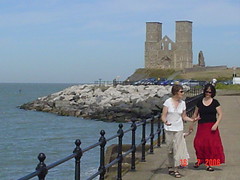
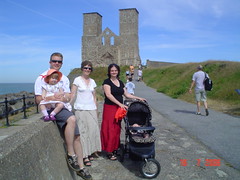
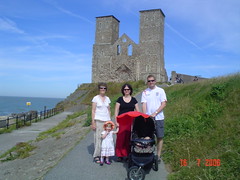
Reculver
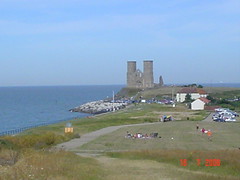
Reculver on the north coast of Kent has 2000 years of history. in AD 45 the Romans landed near here and built a fort. Only half the site is left. In Roman times the coast was perhaps two miles away but now the sea has taken half the fort.
In the 7th century, after Augustine came to Canterbury, a church was built on the fort site. Later it was a monastery then reverted to parish church. But by the end of the 18th century the sea was too close for comfort. A new parish church was built inland. The old church was purchased by Trinity House and the towers kept to aid navigation.
In the 7th century, after Augustine came to Canterbury, a church was built on the fort site. Later it was a monastery then reverted to parish church. But by the end of the 18th century the sea was too close for comfort. A new parish church was built inland. The old church was purchased by Trinity House and the towers kept to aid navigation.
Thursday, July 13, 2006
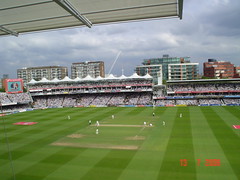
From Lord's grandstand
The view from the top tier of the Lord's grandstand. Collingwood and Cook putting on a record 4th wicket partnership for Engalnd against Pakistan thanks to about six dropped catches, three from the same slip fielder.
A record at Lords
Kaneria bowls to Collingwood on the first day of the first test against Pakistan. It was my most expensive day ever at a match. On the way I lost my ticket provided by a customer who is a M.C.C. member so i had to but another, this time in the top of the grandstand. a fantastic if very expensive seat. Paul Collingwood and Alastair Cook posted an
England fourth-wicket record stand against Pakistan of 221 to end day one 309-3 .
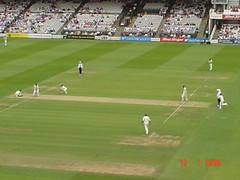
England fourth-wicket record stand against Pakistan of 221 to end day one 309-3 .
Wednesday, July 12, 2006
Southgate 20:20 Cricket
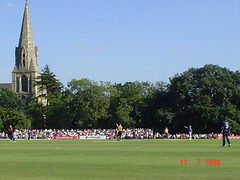
Hampshire, who made 111 all out, prepare to open against Middlesex at Southgate, a ground to contrast with Lords, the county's main ground. It was my first visit here. Middlesex's win by nine wickets was their only 20:20 victory this season. Man of the match, a batsman called Weeks! This Weeks was sunburned.
Saturday, July 08, 2006
Two minutes silence
So we are had a national two minutes silence at noon. Am I alone in wondering why? I know what I am remembering on Nov 11 or Remembrance Sunday. I am giving thanks for those who sacrificed their lives for my freedom and praying for peace. But July 7? Is this any more than a Diana like piece of sentimentality?
Minutes silence proliferate at sporting events. Opposing fans often show their lack of respect for someone associated with another team. A minutes applause may be better. But 7/7? Will I be praying for suffering families, for the defeat of the Islamists? For significant inroads by the gospel into Muslim hearts? If, God forbid we have another even worse bombing, will days with silent minutes be multiplied? Am I alone in thinking evil events should not be so remembered? To do this when 52 died devalues what we do on November 11 remembering millions who died for freedom.
Minutes silence proliferate at sporting events. Opposing fans often show their lack of respect for someone associated with another team. A minutes applause may be better. But 7/7? Will I be praying for suffering families, for the defeat of the Islamists? For significant inroads by the gospel into Muslim hearts? If, God forbid we have another even worse bombing, will days with silent minutes be multiplied? Am I alone in thinking evil events should not be so remembered? To do this when 52 died devalues what we do on November 11 remembering millions who died for freedom.
Monday, July 03, 2006
July Beard 2 and Zac
We have reason to look glum. England have just gone out of the World Cup.
Sides trimmed this last month.

Sides trimmed this last month.
Sunday, July 02, 2006
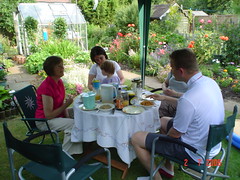
Breakfast in the garden
Sometning new for us in England. Previously we have only breakfasted outdoors in California.
Saturday, July 01, 2006
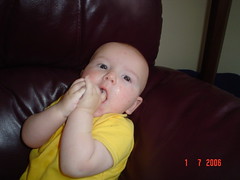
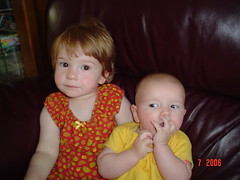
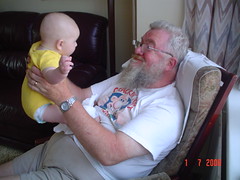

IM Frederick Sewards Trueman 1 July 2006
T'finest bloody fast bowler that ever drew breath.
Frederick Sewards Trueman, when asked how he wanted to be remembered.
-..and I have tearful eyes. He was the first bowler to take 300 test wickets. My youthful memory is black and white TV, Fred at one end Statham at the other opening for England. I saw him bowl several times but regrettably, never on a wicket that suited him
BBC obituary said
Stories about Trueman became the stuff of legend.
On one occasion, when an opposition batsman walked through
the gate onto the outfield, he was told: "Don't bother
shutting it. You'll be back soon."
And when a Cambridge
University student he had just
bowled said "That was a very
good ball, Mr Trueman", he
responded with "Ay, wasted on
thee."
Frederick Sewards Trueman, when asked how he wanted to be remembered.
-..and I have tearful eyes. He was the first bowler to take 300 test wickets. My youthful memory is black and white TV, Fred at one end Statham at the other opening for England. I saw him bowl several times but regrettably, never on a wicket that suited him
BBC obituary said
Stories about Trueman became the stuff of legend.
On one occasion, when an opposition batsman walked through
the gate onto the outfield, he was told: "Don't bother
shutting it. You'll be back soon."
And when a Cambridge
University student he had just
bowled said "That was a very
good ball, Mr Trueman", he
responded with "Ay, wasted on
thee."
A year's reading
Having now for a year blogged my monthly book reading it time to analyse my reading.
1. History 32 books
2. Biography 20
3. Islam 9
4. Theology 7
5. Humour 5
6. Politics 4
7= Devotional 3
Chilidren's 3
Novels 3
10=Psychology 2
Mission 2
Quotations 2
Trivia 2
14=Letters 1
Sport 1
Commentaries 1
97 books in the year. Before the internet I might have read more. When I took a daily paper I read fewer books. Most of the books were from the local library. I own 34 of those i read of which half were gifts from kind friends and family. Most books i have reviewed on amazon.co.uk as well as on my blog.
1. History 32 books
2. Biography 20
3. Islam 9
4. Theology 7
5. Humour 5
6. Politics 4
7= Devotional 3
Chilidren's 3
Novels 3
10=Psychology 2
Mission 2
Quotations 2
Trivia 2
14=Letters 1
Sport 1
Commentaries 1
97 books in the year. Before the internet I might have read more. When I took a daily paper I read fewer books. Most of the books were from the local library. I own 34 of those i read of which half were gifts from kind friends and family. Most books i have reviewed on amazon.co.uk as well as on my blog.
Thursday, June 29, 2006
Books read in June (12)
1. Religion Versus Empire?: British Protestant Missionaries and Overseas Expansion, 1700-1914 - Andrew Porter
Were missionaries enthusiastic imperialists? Did the British Empire promote Christian missions? Read this book and find out. It is not an easy read being an academic study which ranges far and wide in time and space but you will finish it far better informed about empire and missions.
At the start we have missionaries in the most difficult of environments, West Indian slave plantations where most owners hated missionaries and some use violence against them. We are taken to South Africa and see missionaries struggling to be more humane than Boers or British government. We are taken to India and see an East India Company that did want the locals's religion disturbed. Then with evangelical influence in the home country the situation changed.
The author writes with sympathy for the self sacrifice of these Christian pioneers and their determination to but the spread of the gospel to the fore. Sometimes I wonder if he is accurate. Did Granville Sharpe actually go to Africa to establish the settlement which became Sierra Leone?
I think the author could have been more critical of colonial governors such as Lugard whose indirect rule in Northern Nigeria helped the spread of Islam while severely restricting Christian mission.
2. The Cricketer's Quotation Book - David Rayvern Allen
If like me you love cricket and quotations this book will have you in heaven. Quotes are here form 1699 onwards. If you cannot get to see a game played live or on TV, read this and cricket will unfold before you. You will find literary giants who loved the game, a few who did not, plus quotes from the great cricket
3. The Little Book of How to Survive the Big 60 - Aubrey Dillon-Malone
Just 90 quotations on getting older with a smile. George Burns is the expert and he is here. It will give you some smiles to crease your wrinkles.writers. It should be next to Wisden on the cricket lovers book shelf.
4. Napoleon (Reputations Series.) R.S. Alexander
This is the fourth book I have read in the reputations series and the least satisfactory.
If you want to know the biography of the great man, this is not one. His life is given 26 pages. Then we have Napoleon as inspiration for left and right in Europe which seems to me more about how his memory has been misused than an assessment of his reputation. There is extensive writing on the Little Corporal in literature and art including modern film. Finally the author discuses whether the Emperor was a conqueror or unifier in Europe, a question most readers will have little difficulty in answering.
I found this a hard read which did not grip my interest nor really inform me about a great soldier and ruler.
5. Oliver Cromwell - Peter Gaunt
This is the best biography of Cromwell which I have read. It is concise and an easy read. Particularly pleasing is how the author gives criticism of many sources on Cromwell to assess their credibility for many are from those with cause to hate him or so late to be of doubtful provenance. Despite losing some favorite quotes this way one is given plenty of others from Oliver himself which confirm that this was no hypocritical ambitious dissembler but a man who believed he was guided and blessed by Providence to lead and rule .
The speed of the transformation from a little known farmer to the greatest military leader on Briish soil and then to head of state is truly astonishing. Gaunt has a good analysis of the reasons why Cromwell refused the crown and of his much criticised Irish campaign.
I found this a very fair book. The reader is informed that you cannot understand Cromwell through modern secularist spectacles. You have to understand some 17th century theology to see what motivated this man. I think the author is very fair in giving us the views of those critical of Cromwell though showing that some critics, like Clarendon found much to admire in Oliver. He ultimately failed to get his godly reformation established but he was a champion of liberty before its time. Here is no self agrandising dictator but a man who only rules with his council of state and written constitution. He never sought the wealth and luxury of kings.
6. Occidentalism: The West in the Eyes of Its Enemies - Ian Buruma & Avishai Margalit
This is a short well written book by, as far as I can tell, two academics, one American and one Israeli. They define their subject like this. "Occidentalism can be seen as the expression of a bitter resentment toward an offensive display of superiority by the West, based on the alleged superiority of reason.' They say, " More corrosive even than military imperialism is the imperialism of the mind imposed by spreading the western belief in scientism, the faith in science as the only way to gain knowledge." p.95.
They start with a meeting of Japanese scholars in 1942 asking how to overcome the modern. The modern is typified by the city, materialism, individualism and immorality. The history of the city as whore is discussed. Individualism is blamed on the West's reformation heritage. From Romanticism's rejection of Enlightenment rationalism we are shown how other cultures have emphasised the reason of heart not head and the importance of community. We are given a link from Romanticism to Islamism, even via Russian Orthodoxy and Marxism. It is a fascinating journey. the West is hated out of envy but more than envy too.
The authors are understanding of Islam showing suicide bombing as a recent innovation condemned by main stream Islam. Islam must deal with Islamists, but one wonders if this is any more than a hope. I wonder if they do give enough weight to the mainstream theology that says Islam must rule and all the world submit. The unique thing about the Islamists seems to me to be their methods of achieving this alone.
I recommend this book as helping us to see ourselves as others see us. Zealous Christians will be just as critical of the West's rationalism, materialism, individualism, exploitation and sexual immorality just like any Occidentalist.
7. The West and the Rest: Globalisation and the Terrorist Threat by Roger Scruton
Roger Scruton has written a timely warning about the dangers facing the West where nations have lost pride in their own cultures. He sees the West under threat, particularly from Islam. "Freedoms that western citizens take for granted are all but unheard of in Islamic countries, and while no Western citizens are fleeing from the West, 70% of the world's refugees are Muslims fleeing from places where their religion is the official doctrine. Moreover, those refugees are all fleeing to the West, recognizing no other place as able to grant the opportunities, freedoms and personal safety that they despair of finding at home. "p.ix
The Social Contract is sen as binding in the west where church and state are separated. In Islam, loyalty to the umma transcends all other loyalties. In the West Christianity has been the most influential cultural force . One way it is different from Islam is forgiveness. " ... one must recognize that the idea of forgiveness, symbolized in the Cross, distinguishes the Christian from the Muslim inheritance."p.38. This doctrine is compatible with defensive warfare but not with terrorism. With a doctrine of forgiveness there can be a political order without reference to tribe of faith, in which even the most fundamental differences can be accommodated provided there is territorial jurisdiction within established national borders. Islam demands a higher loyalty, a state never separated from religion, an other monotheists merely tolerated as secon class dhimmis without full citizen rights. Belonging in the West comes from loyalty to a nation state. Islam has a higher loyalty which must prevail. Loyalty is never ultimately to the nation state if that state is in conflict with an Islamic one. Scruton shows how Muslims must be rues by Holy Law, Shari'a. He shows the development of Islamism from Wahabbism and the Muslim brotherhood and how globalization has enabled the terrorists to use the western systems they despise to threaten us today.
So the diagnosis of what ails us is well done. What is Scxruton's prescribed cure. Strengthen the nation state, not the E.U. for which no-one will die. Stop bureaucratic legislation Have immigration policies aimed at integration not multiculturalism. Take pride in our own culture. Stop its denigration. It will be an uphill climb.
8. Menace in Europe: Why the Continent's Crisis Is America's, Too by Claire Berlinski
The author appears to be a young American secular Jewish woman who has spent a lot of time in different European countries. She writes in a popular style far removed from any academic pretence of objectivity and has aimed at the American market. Her approach is that of a journalistic travel book which may leave one wondering how representative her contacts and friends are, for from them she gives us her generalizations on the state of Europe. Foe example her studies at Oxford lead her to write about British Muslims who are high achievers, not your average poor immigrants from the Indian sub-continent.. Her other source on the English Muslim situation is from contemporary novels. This is not exactly first hand research into the lives of ordinary Muslims.
There are though some observations one rarely hears. Richard Dawkins is the promulgator of "the condescending strain of atheism ...His remarkably unattractive world view manges not only to be spiritually empty but also intellectually embarrassing". However her analysis of religion in Britain is perfunctory and I really do doubt that Islam is the fastest growing religion by conversion among native Britons. However this is the only book I have read that tells us the British approach to multiculturalism is so monumentally flawed as to waste public money translating publications into "community languages" where the people in these communities who have not learned English are illiterate in their own mother tongues .
The authors contrast with France where ethnic communities are not officially recognized and assimilation into all things French is encouraged is most enlightening. After reading this book one has a much better understanding of the French secularist imposition of uniformity in the public square.
With the present inability of most European countries to have self sustaining reproduction rates the demographic decline of Europe is foreseen as is the probable devastating economic consequences. There are timely warnings here. but one also has to wade through some awful reproduction of the lyrics of a revolting German pop group as she warns us about resurgent nationalism.
Once again here is a book often good on the diagnosis of Europe's problems but giving no prescriptions for a cure. I am left wondering why the author divides her time between Paris and Istanbul, not living in the US which is the envy of the world and where cultural diversity is, she reckons, so much better, even the restaurants.
9. A Mad, Bad, and Dangerous People?: England 1783-1846 (New Oxford History of England)
by Boyd Hilton
From the French Revolution to Chartism, life in England is comprehensively surveyed. This is not only political history but all of English life is surveyed including religion and culture. It is interesting to read of the curtailment of civil liberties after the French Revolution and the threat of Napoleonic invasion. One sees parallels with todays civil repressive measures in the face of the war on terrorism. Full of interesting detail like the first man to go back to having a beard in the 1820s. I shall want to read more in this series.
10. The Bible (NIV)
It is over 30 years since i started to use M'Cheyne's daily Bible reading schedule which aims to cover the whole bible in a year. Since then I have changed to two OT chapters, one NT and a Psalm daily. This gets on through the whole Bible in a year and through paslams twice. I confess it is only in recent years that I have really been disciplined enough to do yhis every day. Previously there were times missed then passages to catch up with
11. Londonistan: How Britain Is Creating a Terror State Within by Melanie Phillips
"According to British officials, up to 16,000 British Muslims either are actively engaged in or support terrorist activity, while up to 3,000 are estimated to have passed through Al Qaeda training camps, with several hundred thought to be primed to attack the United Kingdom." So the author quotes a 2004 Home Office paper which alerts us to the treat facing this country. Melanie Phillips tells how London has been allowed to be the world centre of Islamist plotting by Muslims not able to live in their own countries.
Britain has a long history of harbouring political refugees but in former centuries, people like Marx were not planning the overthrow of our country or Western civilisation. Islamist radicals are. She shows how the judiciary have used human rights legislation to stop the government imprisoning such people when eventually they woke up to the threat. This book carries repeated assertions that the majority Muslim population are peaceful yet argues that Muslim leaders have failed to condemn all terrorism, especially that against Israel.
She identifies multicultual paralysis as the reason that our authorities will not link Islam with terrorism, preferring to explain it as a violent reaction to the war in Iraq. Multiculturalism has lead to minority grousp claiming victim status. The cultural heritage of a Christian country is denied. The intellectual establishment has no concept of the value of our history having succumbed to a post-modernist denial of objective truth. The Muslim minority demands privileges in a way no other minority does wanting Shari'sa law recognised. Islam wants to take over our culture and our establishment is in denial. That includes many church leaders too. Ignorance of the threat goes right up to the heir to the throne whose rosy view of Islam seems to ignore what the Shari'a says about adulterers.
Where I do think the author goes too far is in her support for Zionism. She rightly exposes the chronic anti-semitism in the Muslim world and its hypocrisy over the Palestinians, but she seems to label any non-zionist as anti-semitic. Replacement theology, believing that the church is now God's covenant people and that Jews do not have a divine right to the land of Palestine is not to deny the right of the State of Israel to exist. But this is a minor aberration in an otherwise excellent book.
But as usual in books about the growth of Islam in Europe, brilliant diagnosis is not followed by convincing offering of remedies. She offers, stop appeasing terrorism, realise this is a war of religious ideology, see the folly of multiculturalism which does not demand loyalty to the nation state and acceptance of the majority culture, repeal the Human Rights act, withdraw from the European Convention on human Rights and the U.N. Convention on Refugees, restate the primacy of British culture and citizenship, address the cultural deformities of moral relativism. I agree with her, we must stop sleepwalking into cultural oblivion.
12. Return to the Hiding Place by Hans Poley
Hans Poley, was the first person hidden from the Nazis by the Ten Boom family. He was a Christian university student who refused the German demand to affirm his loyalty to their regime. Instead he hid at the Ten boom home before they had their building alterations done. Six people eventually survived the Gestapo raid on the house, hidden so well that friendly Dutch police could not find the hiding place despite direction given to it. Poley was not there though. He had been arrested while on a Resistance mission. By the grace of God the Gestapo did not find the gun concealed at his parents' home.Hhe was imprisoned but released before the war ended.
This is a fascinating account of the remarkable faith of the Ten Boons which lead them to do great things to help those being hunted for their lives. There is interesting debate on the ethics of deception.
This is a book to move you to tears and also to give thanks to God for the reality of true faith which leads to great works by ordinary people.
Were missionaries enthusiastic imperialists? Did the British Empire promote Christian missions? Read this book and find out. It is not an easy read being an academic study which ranges far and wide in time and space but you will finish it far better informed about empire and missions.
At the start we have missionaries in the most difficult of environments, West Indian slave plantations where most owners hated missionaries and some use violence against them. We are taken to South Africa and see missionaries struggling to be more humane than Boers or British government. We are taken to India and see an East India Company that did want the locals's religion disturbed. Then with evangelical influence in the home country the situation changed.
The author writes with sympathy for the self sacrifice of these Christian pioneers and their determination to but the spread of the gospel to the fore. Sometimes I wonder if he is accurate. Did Granville Sharpe actually go to Africa to establish the settlement which became Sierra Leone?
I think the author could have been more critical of colonial governors such as Lugard whose indirect rule in Northern Nigeria helped the spread of Islam while severely restricting Christian mission.
2. The Cricketer's Quotation Book - David Rayvern Allen
If like me you love cricket and quotations this book will have you in heaven. Quotes are here form 1699 onwards. If you cannot get to see a game played live or on TV, read this and cricket will unfold before you. You will find literary giants who loved the game, a few who did not, plus quotes from the great cricket
3. The Little Book of How to Survive the Big 60 - Aubrey Dillon-Malone
Just 90 quotations on getting older with a smile. George Burns is the expert and he is here. It will give you some smiles to crease your wrinkles.writers. It should be next to Wisden on the cricket lovers book shelf.
4. Napoleon (Reputations Series.) R.S. Alexander
This is the fourth book I have read in the reputations series and the least satisfactory.
If you want to know the biography of the great man, this is not one. His life is given 26 pages. Then we have Napoleon as inspiration for left and right in Europe which seems to me more about how his memory has been misused than an assessment of his reputation. There is extensive writing on the Little Corporal in literature and art including modern film. Finally the author discuses whether the Emperor was a conqueror or unifier in Europe, a question most readers will have little difficulty in answering.
I found this a hard read which did not grip my interest nor really inform me about a great soldier and ruler.
5. Oliver Cromwell - Peter Gaunt
This is the best biography of Cromwell which I have read. It is concise and an easy read. Particularly pleasing is how the author gives criticism of many sources on Cromwell to assess their credibility for many are from those with cause to hate him or so late to be of doubtful provenance. Despite losing some favorite quotes this way one is given plenty of others from Oliver himself which confirm that this was no hypocritical ambitious dissembler but a man who believed he was guided and blessed by Providence to lead and rule .
The speed of the transformation from a little known farmer to the greatest military leader on Briish soil and then to head of state is truly astonishing. Gaunt has a good analysis of the reasons why Cromwell refused the crown and of his much criticised Irish campaign.
I found this a very fair book. The reader is informed that you cannot understand Cromwell through modern secularist spectacles. You have to understand some 17th century theology to see what motivated this man. I think the author is very fair in giving us the views of those critical of Cromwell though showing that some critics, like Clarendon found much to admire in Oliver. He ultimately failed to get his godly reformation established but he was a champion of liberty before its time. Here is no self agrandising dictator but a man who only rules with his council of state and written constitution. He never sought the wealth and luxury of kings.
6. Occidentalism: The West in the Eyes of Its Enemies - Ian Buruma & Avishai Margalit
This is a short well written book by, as far as I can tell, two academics, one American and one Israeli. They define their subject like this. "Occidentalism can be seen as the expression of a bitter resentment toward an offensive display of superiority by the West, based on the alleged superiority of reason.' They say, " More corrosive even than military imperialism is the imperialism of the mind imposed by spreading the western belief in scientism, the faith in science as the only way to gain knowledge." p.95.
They start with a meeting of Japanese scholars in 1942 asking how to overcome the modern. The modern is typified by the city, materialism, individualism and immorality. The history of the city as whore is discussed. Individualism is blamed on the West's reformation heritage. From Romanticism's rejection of Enlightenment rationalism we are shown how other cultures have emphasised the reason of heart not head and the importance of community. We are given a link from Romanticism to Islamism, even via Russian Orthodoxy and Marxism. It is a fascinating journey. the West is hated out of envy but more than envy too.
The authors are understanding of Islam showing suicide bombing as a recent innovation condemned by main stream Islam. Islam must deal with Islamists, but one wonders if this is any more than a hope. I wonder if they do give enough weight to the mainstream theology that says Islam must rule and all the world submit. The unique thing about the Islamists seems to me to be their methods of achieving this alone.
I recommend this book as helping us to see ourselves as others see us. Zealous Christians will be just as critical of the West's rationalism, materialism, individualism, exploitation and sexual immorality just like any Occidentalist.
7. The West and the Rest: Globalisation and the Terrorist Threat by Roger Scruton
Roger Scruton has written a timely warning about the dangers facing the West where nations have lost pride in their own cultures. He sees the West under threat, particularly from Islam. "Freedoms that western citizens take for granted are all but unheard of in Islamic countries, and while no Western citizens are fleeing from the West, 70% of the world's refugees are Muslims fleeing from places where their religion is the official doctrine. Moreover, those refugees are all fleeing to the West, recognizing no other place as able to grant the opportunities, freedoms and personal safety that they despair of finding at home. "p.ix
The Social Contract is sen as binding in the west where church and state are separated. In Islam, loyalty to the umma transcends all other loyalties. In the West Christianity has been the most influential cultural force . One way it is different from Islam is forgiveness. " ... one must recognize that the idea of forgiveness, symbolized in the Cross, distinguishes the Christian from the Muslim inheritance."p.38. This doctrine is compatible with defensive warfare but not with terrorism. With a doctrine of forgiveness there can be a political order without reference to tribe of faith, in which even the most fundamental differences can be accommodated provided there is territorial jurisdiction within established national borders. Islam demands a higher loyalty, a state never separated from religion, an other monotheists merely tolerated as secon class dhimmis without full citizen rights. Belonging in the West comes from loyalty to a nation state. Islam has a higher loyalty which must prevail. Loyalty is never ultimately to the nation state if that state is in conflict with an Islamic one. Scruton shows how Muslims must be rues by Holy Law, Shari'a. He shows the development of Islamism from Wahabbism and the Muslim brotherhood and how globalization has enabled the terrorists to use the western systems they despise to threaten us today.
So the diagnosis of what ails us is well done. What is Scxruton's prescribed cure. Strengthen the nation state, not the E.U. for which no-one will die. Stop bureaucratic legislation Have immigration policies aimed at integration not multiculturalism. Take pride in our own culture. Stop its denigration. It will be an uphill climb.
8. Menace in Europe: Why the Continent's Crisis Is America's, Too by Claire Berlinski
The author appears to be a young American secular Jewish woman who has spent a lot of time in different European countries. She writes in a popular style far removed from any academic pretence of objectivity and has aimed at the American market. Her approach is that of a journalistic travel book which may leave one wondering how representative her contacts and friends are, for from them she gives us her generalizations on the state of Europe. Foe example her studies at Oxford lead her to write about British Muslims who are high achievers, not your average poor immigrants from the Indian sub-continent.. Her other source on the English Muslim situation is from contemporary novels. This is not exactly first hand research into the lives of ordinary Muslims.
There are though some observations one rarely hears. Richard Dawkins is the promulgator of "the condescending strain of atheism ...His remarkably unattractive world view manges not only to be spiritually empty but also intellectually embarrassing". However her analysis of religion in Britain is perfunctory and I really do doubt that Islam is the fastest growing religion by conversion among native Britons. However this is the only book I have read that tells us the British approach to multiculturalism is so monumentally flawed as to waste public money translating publications into "community languages" where the people in these communities who have not learned English are illiterate in their own mother tongues .
The authors contrast with France where ethnic communities are not officially recognized and assimilation into all things French is encouraged is most enlightening. After reading this book one has a much better understanding of the French secularist imposition of uniformity in the public square.
With the present inability of most European countries to have self sustaining reproduction rates the demographic decline of Europe is foreseen as is the probable devastating economic consequences. There are timely warnings here. but one also has to wade through some awful reproduction of the lyrics of a revolting German pop group as she warns us about resurgent nationalism.
Once again here is a book often good on the diagnosis of Europe's problems but giving no prescriptions for a cure. I am left wondering why the author divides her time between Paris and Istanbul, not living in the US which is the envy of the world and where cultural diversity is, she reckons, so much better, even the restaurants.
9. A Mad, Bad, and Dangerous People?: England 1783-1846 (New Oxford History of England)
by Boyd Hilton
From the French Revolution to Chartism, life in England is comprehensively surveyed. This is not only political history but all of English life is surveyed including religion and culture. It is interesting to read of the curtailment of civil liberties after the French Revolution and the threat of Napoleonic invasion. One sees parallels with todays civil repressive measures in the face of the war on terrorism. Full of interesting detail like the first man to go back to having a beard in the 1820s. I shall want to read more in this series.
10. The Bible (NIV)
It is over 30 years since i started to use M'Cheyne's daily Bible reading schedule which aims to cover the whole bible in a year. Since then I have changed to two OT chapters, one NT and a Psalm daily. This gets on through the whole Bible in a year and through paslams twice. I confess it is only in recent years that I have really been disciplined enough to do yhis every day. Previously there were times missed then passages to catch up with
11. Londonistan: How Britain Is Creating a Terror State Within by Melanie Phillips
"According to British officials, up to 16,000 British Muslims either are actively engaged in or support terrorist activity, while up to 3,000 are estimated to have passed through Al Qaeda training camps, with several hundred thought to be primed to attack the United Kingdom." So the author quotes a 2004 Home Office paper which alerts us to the treat facing this country. Melanie Phillips tells how London has been allowed to be the world centre of Islamist plotting by Muslims not able to live in their own countries.
Britain has a long history of harbouring political refugees but in former centuries, people like Marx were not planning the overthrow of our country or Western civilisation. Islamist radicals are. She shows how the judiciary have used human rights legislation to stop the government imprisoning such people when eventually they woke up to the threat. This book carries repeated assertions that the majority Muslim population are peaceful yet argues that Muslim leaders have failed to condemn all terrorism, especially that against Israel.
She identifies multicultual paralysis as the reason that our authorities will not link Islam with terrorism, preferring to explain it as a violent reaction to the war in Iraq. Multiculturalism has lead to minority grousp claiming victim status. The cultural heritage of a Christian country is denied. The intellectual establishment has no concept of the value of our history having succumbed to a post-modernist denial of objective truth. The Muslim minority demands privileges in a way no other minority does wanting Shari'sa law recognised. Islam wants to take over our culture and our establishment is in denial. That includes many church leaders too. Ignorance of the threat goes right up to the heir to the throne whose rosy view of Islam seems to ignore what the Shari'a says about adulterers.
Where I do think the author goes too far is in her support for Zionism. She rightly exposes the chronic anti-semitism in the Muslim world and its hypocrisy over the Palestinians, but she seems to label any non-zionist as anti-semitic. Replacement theology, believing that the church is now God's covenant people and that Jews do not have a divine right to the land of Palestine is not to deny the right of the State of Israel to exist. But this is a minor aberration in an otherwise excellent book.
But as usual in books about the growth of Islam in Europe, brilliant diagnosis is not followed by convincing offering of remedies. She offers, stop appeasing terrorism, realise this is a war of religious ideology, see the folly of multiculturalism which does not demand loyalty to the nation state and acceptance of the majority culture, repeal the Human Rights act, withdraw from the European Convention on human Rights and the U.N. Convention on Refugees, restate the primacy of British culture and citizenship, address the cultural deformities of moral relativism. I agree with her, we must stop sleepwalking into cultural oblivion.
12. Return to the Hiding Place by Hans Poley
Hans Poley, was the first person hidden from the Nazis by the Ten Boom family. He was a Christian university student who refused the German demand to affirm his loyalty to their regime. Instead he hid at the Ten boom home before they had their building alterations done. Six people eventually survived the Gestapo raid on the house, hidden so well that friendly Dutch police could not find the hiding place despite direction given to it. Poley was not there though. He had been arrested while on a Resistance mission. By the grace of God the Gestapo did not find the gun concealed at his parents' home.Hhe was imprisoned but released before the war ended.
This is a fascinating account of the remarkable faith of the Ten Boons which lead them to do great things to help those being hunted for their lives. There is interesting debate on the ethics of deception.
This is a book to move you to tears and also to give thanks to God for the reality of true faith which leads to great works by ordinary people.
Sunday, June 25, 2006
A beard to dye for
Mark is a contender with me for beard ot the year at our church, but my contention is that dyeing is cheating.
Shivering May not flaming June
Ne'er cast a clout 'til May be out, said my old Grandma. This was taken on Spring Bank Holiday in Richmond Park, shivering in the wind on a church picnic. It would have been on Whit Monday had not Harold Wilson changed and secularised our calendar by adding May Day to our public holidays and moving this later holiday away from the variable date of Pentecost.
Sylvester Jacobs
Syl is an old friend. he is originally from Oklahoma, but having married an English wife he has lived in England for over 36 years. We first met when our church was started in 1969. He was then a proffesional photographer who took his photos withut having his subjects pose. You were asked to be yourself and he snapped you cheeseless as it were. So when I photograph him, my aim is to do the same. Here he is taking wedding photos.
Katy at Hampton Court
Katy at Hampton Court, where Henry VIII and Cromwell walked. Evening shadows before the concert.
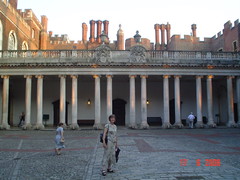
Katherine Jenkins
Katherine Jenkins starts her concert at Hampton Court Palace wearing the first of four dresses. My musical wife reckons her singing is too much one style. I say her gowns aren't ! I enjoyed the concert but missed hearing anything Welsh. Encores of Land of Hope and Glory, and Rule Brittania were great.
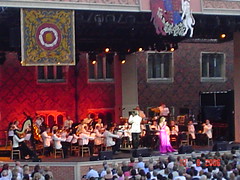
IPC Synod Members, 2006
IPC Synod Members, 2006, from England, Wales, USA, Canada, France, Belgium, Italy, Romania, Korea and a former Soviet republic, So we really are International Presbyterian Church. I have been a member of the synod since 1983, a length of service exceded by only one brother in the photo.
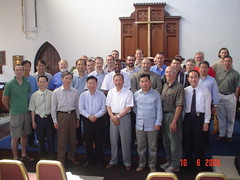
Moderator's Address
Bill Nikides, retiring moderator, addresses our church synod at Kingston Korean Presbyterian Church. Fellowship was good, Korean lunch great - lots of kimchi. After lunch I sneaked off to find a pub where i watched England start their World Cup with a 1-0 victory over Paraguay. I had asked the presbytery to meet another day but with only one other Englishman among us I did not get my way.
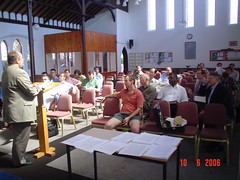
Pharmacy and Mental Health
Wednesday evening i was invited to address a meeting of Barnet Voice for Mental Health on my work as a pharmacist. I looked at the changes I have seen in dispensing psychotropic drugs in the last 43 years. I explained why I'd rather be in counselling than dispensing as drugs only help control symptoms, they do not touch causes of mental problems. I also said that I could not do secular counselling, It has to be wholistic and not rule out the spiritual or moral imperatives as is the fashion today. I did my best to answer questions on the specific drugs my hearers wanted to ask about. I explained why, as a man surrounded by such drugs, i would never take any. Bar tenders should beware lest opportunity leads to alcoholism.
Monday, June 19, 2006
Syl and Randy
Randy and Syl, two of our church member guests and long time friends. Syl and his wife Janet were with us founder members of IPC Ealing in 1969.
Catering sisters
Rachel and Debbie helped with decorations and food. This must have been taken before the table was weighed down with many desserts.
Friday, June 16, 2006
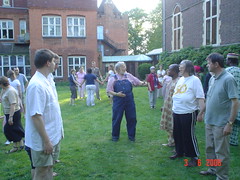
Quiz
David gave a quiz to see how well our guests knew us. In the background is Godwin who we helped train as a nurse in Nigeria in the early 70s.
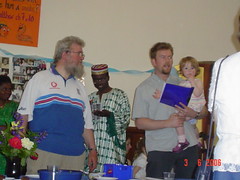
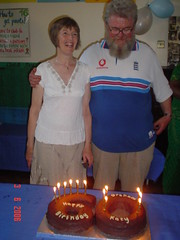
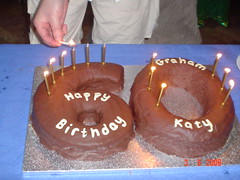
Sahara's cake
We were not the only celebrants. Next day, June 4, was Sahara's second birthday so she too had a cake.
Church garden
In the 19 th century, this gaden was splendid enough to have attracted a visit by Queen Victoria. Look upon our birthday as a royal garden party.
Under the tree
We had over 100 guests in the church garden with the best weather of the year so far.
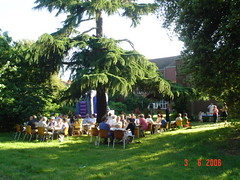
Wednesday, June 14, 2006
13 June 1656 Jews return to England
The last couple of days I have heard mention on BBC Radio of this anniversary of Oliver Cromwell allowing the Jews to return to England. However, in line with either its usual secularist bias or out of ignorance I have not heard mention of the main reason Oliver wanted the Jews in England. All I have heard is the economic reason. Cromwell's real reason? Oliver believed that before Christ returns the Jews must be converted. How could they be converted without hearing the gospel? He had them return to England so they could hear the gospel.
Tuesday, June 13, 2006
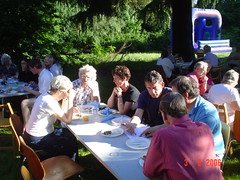
Friday, June 09, 2006
Bouncy adults
The problem with having a bouncy casle is the bouncing adults. Auntie Debbie frames Hannah, with her attendants from USA and China. Cousin Sahara investigates.
Barbeque 3
Our chiefs of the barbeque, Carlos from Brazil and Carla from Colombia. The only people I know who conduct one conversation in two languages, Portugese and Spanish.
Subscribe to:
Posts (Atom)
