Showing posts with label mission. Show all posts

Saturday, August 05, 2017

August 5: Mary Slessor


by davidtmyers
In these United States, we are accustomed to seeing various historical figures from the early days of our country on our paper currency. From 1997 to 2009, the people of Scotland were used to seeing the picture of a Presbyterian missionary by the name of Mary Slessor on their ten pound bank-note. On one side of the bill, Mary Slessor was seen holding a child and literally surrounded by other children from that nation of Nigeria. On the other side of the legal tender, there was a map of her mission station in what is now eastern Nigeria. It is still legal tender in Scotland, even though her picture on the ten pound note has been replaced by someone else.
Mary Slessor was born into a family of seven children in 1848. Her father, who was an alcoholic, passed away, which left her mother struggling to support the large family. To help out, Mary, at age eleven, worked in the local mill. She is described by Dr. David Calhoun, professor emeritus of Covenant Theological Seminary, as “a tough, street smart girl, with striking blue eyes, red hair, and a flaming temper.” At age fifteen, with just a few short hours of sixty hours a week as a “mill-lassie,” she also taught a Sunday School class in her local Presbyterian church, supported a youth group composed of tough local kids, and became “an angel of mercy in miserable homes” in Dundee, Scotland.
As a result of the influence of her mother, who made available to the family the stories of missionary exploits from the Missionary Record magazine of the United Presbyterian Church, Mary received a call from the Lord to be a missionary in Calabar, Nigeria. Sailing on August 5, 1876 on the SS Ethiopia, she reached her target area.
After centuries of slavery in the area, human life was cheapened, tribes were divided, and the culture, such as it was, perverted. Especially was this so whenever African couples would bring twins into the world. One of the two children was looked upon as a child of the devil, but because no one would identify which one was demoniac, both were killed, or left to die in the jungle. Enter Mary Slessor into this whole scene. She literally rescued hundreds of these castaway children. One could not enter her missionary home without finding a dozen or so children in it.
Further, this missionary lady obviously believed the text of 1 Corinthians 9:22 where Paul writes, “I have become all things to all . . . so that I may be all means save some.” And so this Scot lady became African in all things, in eating their food, in dressing in their clothes, and learning their language. She wanted to become an African to win Africans to Christ!
It wasn’t long before the British government recognized her ability to minister to Africans. She was appointed a vice-consul – the first ever woman to be so appointed in the whole of the British Empire — by the new consul-general of her territory. David Calhoun states that she “could prevent battles, out-shout chiefs, and stop riots merely by walking into the middle of them.”
Weakened by fever throughout her life and service in the country, she finally succumbed on January 13, 1915.

Words to Live By:
Our focus has been on this remarkable servant of Christ, but consider how her mother, in circumstances less than ideal, influenced Mary’s life for the mission field. She did it by subscribing to a mission magazine which was reading material in her home. Other ideas would be the reading of missionary biographies to our children. Having visiting missionaries in your home for rest and recreation on their furlough would be a wonderful help for them and a vital example for your family. And certainly, when your covenant children grow into their teen years, participation on a short-term mission trip might indeed inculcate a mission heart all of their life. But most important, the frequent prayer of Matthew 9:38 ought to be practiced in the home, namely, “beseech the Lord of the harvest to send out workers into His harvest.:
For Further Study:There is a chapter on Mary Slessor in the recent work by William W.J. Knox, Lives of Scottish Women: Women and Scottish Society. (Edinburgh: Edinburgh University Press, 2006). Other works on her life and ministry include Mary Slessor of Calabar: Pioneering Missionary, by W.P. Livingstone (1915); The Expendable Mary Slessor, by James Buchan (1980); and Mary Slessor, by E. Robertson (2001).

Sunday, March 12, 2017

Faith triumphs in adverse providence

On 11Mar 1812 William Carey’s Work Went up in Flames
"AT ABOUT SIX in the evening on this day, 11 March 1812, fire broke out in a print shop at Serampore, India. The mission staff there were able to rescue a few deeds and financial records, but could salvage little more. Around midnight, the roof caved in, sending a pillar of fire high into the sky.
Twelve years of missionary toil went up with those flames. William Carey, pioneer Baptist missionary to India, had produced a polyglot dictionary of several Indian languages. It burned. The conflagration also consumed Scriptures already printed in Indian tongues, Bengali and Sanskrit grammars, and twelve thousand reams of paper. Melted by the fire were fourteen special fonts of Asian typefaces.
Carey was in Calcutta when the disaster struck. When fellow-missionary Joshua Marshman took him the news in the morning, he was so stunned he could not say a word for a several moments. The pair spent the day looking for replacement typefaces, but had to return to Serampore empty-handed.
However, they received good news when they got there. Printer William Ward had found many of the punches and molds for typecasting unharmed in the ruins. With these in hand, they could have the presses running again in a month. The presses themselves were unaffected in an adjacent building, and six weeks later were turning out copies of the Scriptures in two languages.
Carey estimated it would take him twelve months to reconstruct his own work. Although downcast, he wrote, “The loss is heavy, but as traveling a road the second time is usually done with greater ease and certainty than the first time, I trust the work will lose nothing of real value.”
In fact, the catastrophe proved something of a blessing. As the news spread, contributions poured in. Helpers rallied to Carey’s side, restoring what was lost and much more. Before Carey’s death in 1834, the mission had printed and distributed all or part of the Bible in forty-four languages and dialects.
While Carey lay dying, he lamented how unprofitable he had been. A visiting minister asked him about his hope of a future world. “I cannot say I have any very rapturous feelings; but I am confident in the promises of the Lord and wish to leave my eternal interests in his hands,” he replied. He had told his friends earlier, “I am sure that Christ will save all that come unto him; and if I know anything of myself, I think I know that I have come to him.”

Like

Thursday, February 23, 2017

Diary 19 to 22 Feb 17

Sunday, 19th  Adult Sunday School was an interview of a young missionary couple about to start work with a team taking the gospel to an unreached people group in North Africa. For security, the country was not disclosed, nor am I posting their names.  Paul preached form Is 53, good as ever . Then for lunch we lived up to our name of International Presbyterian Church. Our guests were form Kenya and a couple whose background is Canadian, Peruvian and Scottish. Evening sermon as Paul concluding his Jonah series. He told us the main point of both book and chapter is that Jonah had to learn, 'you are a gracious and compassionate God, slow to anger and abounding in love, '

Monday 20th, I finished Spencer's Politically Incorrect Guide to Islam. In the evening we watched the very moving autobiographical WWI film, Vera Brittain's Testament of Youth. Both reviewed on this blog.

Tuesday 21st, There were 8 of us at early IPC prayers, our monthly early meeting. Ealing Lunchtime Talks saw Paul expound all of Rom 11. He gave us the two views of 'all Israel will be saved' declining to state his own choice. I mentioned that for me it could not mean a future large scale conversion of ethnic Israel for if so we lose the doctrine of the immanent return of Christ. There are no remaining signs preceding the coming of the Lord. He might come today. Back to no fibre diet in preparation for a second colostomy procedure.

Wednesday 22nd  Cardiologist consultant tells me the since my atrial fibrillation 8 years ago, the heart is stable but he will continue annual appointments but now these are at a Hanwell surgery. I so not need to be a hospital outpatient. I will not describe the messy details of the evening save to say overdosing on laxatives as per the hospital's instruction is a case of 'Runs rabbit runs' together with fasting from noon.


Wednesday, February 22, 2017

Eric Liddell died on this day, 21 February 1945

ON THIS DAY IN 1945 Eric Liddell, Olympian for Christ, died in a Japanese concentration camp.
IN CHINA, Eric Liddell asked his students if they believed Christ’s Sermon on the Mount. When they said they did, he would say “let’s add it on to the end of the Apostles Creed and when you finish saying the Apostles Creed say, ‘I believe in the Sermon on the Mount’.” This was more than rhetoric with him. After the Japanese incarcerated him in a detention camp, he prayed for them. Had not Christ said “love your enemies and pray for those who persecute you?” He challenged fellow-prisoners to pray for the Japanese, too. This was in keeping with his entire adult life. 
Born the son of missionaries, Liddell was a highly athletic rugby star and running champion while studying for the ministry in Scotland. Eventually his swift feet took him to the 1924 Olympics in Paris, where he set a world record in the four hundred meters. His refusal to run on Sunday drew world attention to his faith. After his victory, a friend says the two of them took a pair of American girls to a Tango Tea Dance. 
Following the Olympics, he completed his education and became a missionary in China, where he met and married his wife Florence. He sent her and their daughters to safety in Canada after the Japanese invaded China, but remained himself in danger from Chinese Communists and Japanese invaders. He and Kenneth McAll learned to trust God implicitly for their safety. When McAll was offered a pistol to protect himself against bandits, Eric shouted, “Don’t touch it! If you have that in your pocket you will depend on it rather than God and I would refuse to travel with you.” 
The Japanese incarcerated foreigners in concentration camps. There Eric worked selflessly as a teacher, prisoner representative, and volunteer toting loads for weaker prisoners. Even after he developed headaches from a massive brain tumor, he never complained. Finally he was assigned to one of the camp’s hospital beds. 
He often wrote to Florence and his three girls, the youngest of whom he had never seen. In a letter near the end of his life, he told Florence he had suffered a “slight nervous breakdown” but assured her he was much better after a month in hospital. “Special love to you and the children,” he added. He then turned to his friend Annie Buchan and said, “It’s full surrender” before drifting into a coma from which he never recovered. 
Eric Liddell died on this day, 21 February 1945. Everyone in the camp mourned, for by then his infectious smile and concern for others were widely known. Norman Cliff, one of the young men who witnessed Liddell’s life in the prison camp, believes the champion runner would have taken no credit for his life, but would have said instead, “When you speak of me, give the glory to my master, Jesus Christ.”

Tuesday, February 14, 2017

February 14: Who Are the True Revolutionaries?

by archivist
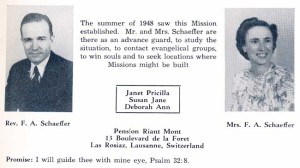
As the Schaeffers were preparing to move to Europe, the following article was published in BIBLICAL MISSIONS, the newsletter of the Independent Board for Presbyterian Foreign Missions, under whose auspices the Schaeffers initially moved onto the European field, with the intent of planting theologically sound churches. The picture shown here is from the January 1949 issue of that same newsletter.
Some will remember that this same title “Revolutionary Christianity” appears as the title of the last chapter of Schaeffer’s book, 
THE CHURCH AT THE END OF THE TWENTIETH CENTURY. The content of the 1948 article is entirely different, though it would be an interesting exercise to compare the two messages. Great minds are always building on prior accomplishments and advances, and I have to think that Schaeffer hadn’t forgotten this 1948 article when he so titled that last chapter of his book in 1970. For instance, does the latter contain an outworking of ideas first formulated in the earlier article.
REVOLUTIONARY CHRISTIANITY
Rev. Francis A. Schaeffer
[Biblical Missions 14.2 (February 1948): 27-31.]
The International Missionary Council met at Whitby, Ontario, in the summer of 1947. In reporting on that meeting, Reinhold Niebuhr’s paper, “Christianity and Crisis,” in its issue of November 10, 1947, gave an account of one of the speeches in which account it stated: “Bishop Neill, successful Oxford missioner, warned lest the church cease to be revolutionary and identify itself with the status quo, the powers that be. ‘Then,’ he said, ‘the revolution goes forward under demonic powers, which God uses to discipline the Church.’ The church losing its mission becomes irrelevant.”
This is a highly significant statement, for it is an illustration of the type of thinking that dominates the modernistic missionary movements, including those that are Barthian and neo-Barthian. Insofar as this statement was presented at this un-Biblical, but influential missionary conference, it is well to analyze carefully this problem in a Bible-believing missionary magazine.
What is meant by “revolutionary Christianity” is that we now need a socialized gospel. To these men the revolutionary concept of Christianity is a part of world betterment through a revolution in the economic field; to them, socialization is the next upward step for Christianity to take. When therefore these men speak of “irrelevant Christianity” they mean Bible-believing Christianity. To them, our historic emphasis that the church’s task is to preach Christ crucified and raised from the dead that men might accept Christ as their personal Saviour and be justified by faith alone, is irrelevant and little more than magic.
The sad thing is that there are some Bible-believing Christians who five excuse for such charges. Orthodoxy is in a constant danger of allowing hat orthodoxy to ossify so that it has no impact on life. Historic, Bible-believing Christianity believes that the task of the church is to preach Christ and Him crucified and that men are justified by faith alone; but his does not mean that after a man has accepted Christ as his Saviour his Christianity should not show, or need not show, in every aspect of his life. In spite of the minority of Bible-believing Christians who are irrelevant, historic Bible-believing Christianity has been and is the true revolutionary Christianity. We have the revolutionary Christianity, not the Modernists and neo-Barthians.
Spiritually
Historic Christianity is revolutionary Spiritually. By revolutionary, I mean that it is totally contrary to all the other religions of the world. Consider the prophets. They were the revolutionists, and they stood alone against their day. Christ, God the Son, when He was on earth, was revolutionary in that He stood alone against His day. Paul was revolutionary, and wherever he went, both Jews and pagans felt the clash of his message against the established religious order. In church history, the outstanding leaders have always been considered revolutionary. Who could be more I revolutionary than Luther standing against the established order of the I Catholic Church? The Reformation Monument in Geneva has carved in stone, “After the darkness came forth light.” Let us never forget that Calvin and those who were with him were revolutionists of the first order in spiritual things. Whitefield and Wesley preached in the fields because the churches were shut to them. The churches were shut to them because these men were spiritual revolutionists against the whole trend of the dead orthodoxy of their day. In our day, has the matter changed? Not a bit. We are the spiritual revolutionists of our hour. All else are agreed against us. The message of the cross is always against the whole world concept around about us. It is against the prince of this world. In spiritual matters, we have the revolutionary message, because the Biblical message in our age, as in every age, is totally contrary to all the religions of the world.
The Christian Century in reporting our attempt, by the grace of God, to form an International Council of Bible-believing Christians, said this attempt was of the Devil. Why have these men resurrected the Devil for us? It has been years since we have heard them mention the Devil. They do not say that the Roman Catholics are motivated by the Devil. At times, it is true, because of growing Roman Catholic political power, we hear them say that Rome is wrong politically, but in religious matters they hold out the hand of fellowship to Rome. They do not say that the Unitarians are of the Devil. In the leadership of the Federal Council of the Churches of Christ in America and in the World Council there are men who individually hold the Unitarian position. They do not even say that the Hindu and the Mohammedan, or the Shintoist is of the Devil. In the Religious Congress that is being called in Boston for the United Nations, the modernistic leaders are calling to these primitive paganisms that they should labor together for world fellowship and brotherhood. However, when it comes to the Bible-believing Christian, then it is a different matter. Why is it that we are the only group they will fight religiously? Because we are the revolutionary group. The simple fact is, that religiously Modernism (including Barthianism and neo-Barthianism). Romanism, Greek Orthodoxy, and the rest, while having differences among themselves, are one in their basic errors.
There are too many who call themselves Bible-believing Christians who are only so because this has been the established position in their youth, not because they are convinced that it is right. They find it rather comfortable to say the old phrases without doing anything about them. Thus, Christianity loses its dynamic power, and dead orthodoxy comes in like a flood. Study what period of church history you will, the first step to heterodoxy has always been a dead orthodoxy.
Such an attitude is not Christian. It is old, but all old things are not good. Christianity is the snatching of brands from the burning. It is the shouting aloud from the pulpit or the stake: “You cannot call Jesus Christ your Lord until you call Him first God and then your personal Saviour.” The Christianity that has moved ahead through the centuries is the Bible-believing Christianity that stands completely against all the other religions of the world. This is true whether they are primitive paganisms, Roman Catholicism, Greek Orthodoxy, old-fashioned Modernism, or neo-Barthianism. True Bible-believing Christianity is never comfortable and it is never fossilized. Christians should know these facts and act upon them. We know that the world will never be normal until Christ comes back and supernaturally makes it so.
Materially
Bible-believing Christianity is also revolutionary in its relationships to the external world. This is what I mean by materially. As the religions of the world are not in line with Christianity, so also the civilizations that are built upon them are not in line with Christianity.
The Bible’s position is that you can only understand a civilization if you see the religion or religions upon which it is built or which are dominantly behind it. This is a part of the complete world-view of Christianity. The true Bible-believing Christian in faith knows that he can in general tell what the civilization of the next generation will be because its basis is found in the religion of this generation.
Now let us ask ourselves. Who are the liberals and who are the reactionaries in our own day? I want to say it very carefully, the Bible-believing Christians arc the true liberals. The modernists, including the Barthians and neo-Barthians, are the reactionaries. What do I mean by this? Bible-believing Christianity, wherever it has gone preaching Christ and Him crucified and raised from the dead and keeping as its primary message justification by faith, has always been followed by certain peripheral and secondary blessings. These blessings have not followed in a day, but they have always come. What are these peripheral blessings—the emancipation of women, the freeing of slaves, the increase of education, and, in general,
a rise in the level of civilization, including the material benefits of a high standard of living. There are many others, but the greatest of the peripheral blessings that have followed historic Bible-believing Christianity has always been an increase in individual liberties. Remember, this is not the primary message of Christianity. It is a purely secondary result of the preaching of the cross.
In the light of this, who is the liberal today and who is the reactionary? Who is continuing the message of individual freedom, and who is leading us back to slavery? It is the Bible-believing Christian who is continuing to insist upon individual freedom all over the world, and equally all over the world it is the modernists and the Barthians and neo-Barthians who are casting away our freedom and leading us back to slavery. In whatever country you read the writings of these men, you find that they believe it is now the Christian’s duty to give up his individual freedom to the state, so that their socialistically-planned economy can come into effect.
In a press release at the Oslo Young People’s Conference, Reinhold Niebuhr said that all laws are under the judgment of Christ, and that this includes those from Scripture and those that were enacted by states and communities. He says that among the laws that we must refashion is the law of property rights, and also the law of individual liberties. What does this mean? It means, these men tell us, that it is our Christian duty to give up our individual liberties to the Socialistic State. They couch their teaching in religious language, but that does not change it.
Who then is the reactionary? The so-called “liberal” is the reactionary, for he would squander all those individual freedoms which our Bible-believing forefathers have won. He decks this road to the slaughter-house of our freedoms with Christian signs and symbols, but it is the road to the death of our freedoms, nevertheless.
Should individual Christians and Bible-believing mission boards be interested in this? I believe they should, for the loss of our freedoms will eventually lead to the loss of the freedom of the preaching of the Gospel.
This totalitarian trend among the modernists is clearly demonstrated in the churches themselves. In the recent church unions in India and Ceylon, the church governments have been led back to the more totalitarian forms.
Thus, it is our message that is truly revolutionary spiritually and in the external world, because our primary message and its secondary results are totally contrary to all the religions of the world and to the civilizations built upon them.
Challenge
However, it would be wrong to finish this article without saying that if we intend to stand in the historic stream of Christianity, we must never close our eyes to the wrongs that do exist in our own external world. The reason the secondary blessings of Christianity have followed the preaching of the Cross is that the true preachers of the Cross have always been willing to point out the evils of their own day. Thus, we should raise our voices against not only the theological “liberal” and the totalitarian trends of our day, but we must be especially careful to point out the weaknesses of our own churches and of our civilization. When we find a Bible-believing Christian who, for example, would turn his back on the cry of the world in its present need for food, we should be the ones to tell him that his Christianity is irrelevant. When our nation would break its solemn promises, we should be the ones to speak most loudly for national integrity. If the church in its time of power prior to 1900 had been faithful in pointing out the abuses of our economic system, I seriously doubt if Communism and near-Communism could have gotten such a hold upon us. It is imperative that we should be the ones to take the lead, especially when it is uncomfortable, in pointing out the evils round about us. Being in the “old paths” does not mean keeping on in things that are wrong. Worldliness is more than smoking, drinking and card playing. A far worse worldliness is keeping quiet when our nation breaks its promises; or sharing, through silence, in murder through mob violence; or by driving men to communism by squeezing them in any of the economic processes.
If the church had not lost its revolutionary message through dead orthodoxy and laziness, modernism could never have come in as it has.
Christianity will always be revolutionary until Christ comes back. We should teach our young people carefully that not only all the false religions are against us, but the civilizations built upon them as well. We should present this to them as a challenge. We have the greatest marching orders that men have ever been given, and when we allow our young people to go on the defensive rather than to march straight forward, it means that we have failed to get across the perennial challenge of our calling.

Saturday, February 11, 2017

What should be the Christian attitude to Muslim immigrants?

First of all let me say most of the world's Moslems are peaceful people and many, for economic reasons mainly, would like to live in the West. But of all immigrant groups, it is from Moslem communities that the security of our country may be threatened. Most Muslims do not sympathise with the violent jihadis yet the threat is there and those radicalised may not be recognised even by family and friends. Violent radicalisation should surprise no-one who has studied Islam, its theology and history. Jihad, violent jihad, is truly part of Islam. In that the jihadis are correct. But Most Muslims are better than this. That incidentally is an interesting difference between Muslims and Christians. Most Muslims are better than what their religion teaches ( they will deny these parts of its teaching). But Christians always fall short God's demands, 'Be ye perfect for I am perfect.' So, to me it is evident that our Border Force should be very diligent in examining all applications by Muslims for entry to UK. Terrorist threats are most likely from Muslims, not those of no or other religions. The only terrorist fatality in UK since 7/7 was soldier Lee Rigby murdered by two men of Nigerian ethnicity who had converted to Islam. Converts are more likely to become jihadis.

So am I advocating a ban on Muslim immigration? No I am not. I am calling for support for due diligence by our security forces who have a very good record of producing us. My real reason for not advocating a ban is not because it would breach international law or be heartless towards genuine refugees or asylum seekers. No. My reason is the same as that of Oliver Cromwell when in the 1640s he welcomed the Jews back to England. Cromwell reasoned that Christ would not return before the Jews were converted. To be converted they needed to hear the gospel. Where better to hear the gospel that England, the centre of Reformation gospel preaching? Similarly, I believe Chist may come any day, but he says those who will be round his throne will be from every tribe and tongue and nation. So, with proper regard for national security, we should welcome people of all nations to our country and preach the gospel to them. In 1970 I went as a Missionary to Nigeria, hoping to preach the gospel there. Now I can share the good news with Nigerians here and others from many nations who have come to UK.

Wednesday, December 09, 2015

Books read in December 2015

1. As the Crow Flies by Jeffrey Archer

Archer is one of the great storytellers of our time. He takes a barrow boy from the East End and follows him becoming a department store magnate with a seat in the Lords. There is the story of a feud with another family, a tale of romance going wrong and illegitimacy where children are kept from knowledge of their parentage. Heirs are hunted in the Antipodes. The story twists and turns and has its surprises.

2. Margaret Thatcher: The Authorized Biography, Volume Two: Everything She Wants by Charles Moore 

 I found Moore's first volume to be excellent and he has once again produced a very detailed and thorough account, this time of the years after the 1982 Falklands war until her third and final general election victory, the only PM to win three elections in a row in the 20th century.  Five years in over 700 pages. Some chapters are more gripping than others because of the nature of their subjects.  Her ups and downs with Reagan, the development of her relationship with Gorbachev, the miners' strike, the Brighton bomb, South Africa and how others viewed her., these are the most interesting. Westland and party infighting are not so fascinating. Once again, Moore is no hagiographer. He paints her warts and all. She talked too much and sometimes did not want to listen. Kind to ordinary people around her she often had poor relations with her ministers and treated some badly. In the case of Geoffrey Howe, that came back to haunt her. I was surprised to learn of tensions with Tebbit who I always thought of as her tough guy.  She was indeed a Marmite character. Moore shows how and why she was both loved and hated. Roll on volume three. How long will we have to wait?

3. Radical Puritans in England 1550 - 1660 (Seminar Studies In History) by R.J. Acheson

An excellent brief introduction to dissent from the established Church of England. It starts with a few isolated separatists and ends with a great diversity in dissent during the Commonwealth. The English desire not to conform seems to come out as a national trait. But there is alsp the folly of trying to enforce conformity. Laud and his followers would have probably survived their professed Arminianism but forcing others to keep all their ceremonies, that was folly.

4. Rogue Lawyer by John Grisham 
Another gripping thriller from the master of legal fiction, Sebastian Rudd is the lawyer who will defend the people other lawyers will not help. He is the only admirable character in the story. But I do want to ask if United States laws, prosecutors and police can really be this bad. The criminals are worse but not a lot. Grisham keeps the reader's attention. I am not going to be a spoiler but I found the ending rather flat. The moral of the story seems to be that if you hire a good lawyer, take his advice.

5. Martyn Lloyd-Jones by Christopher Catherwood

This book is by the eldest grandchild of the renowned preacher, Martyn Lloyd-Jones. He writes to introduce modern Christians to the man considered by many to be the greatest preacher of the last century. He starts with biography then moves on to more controversial matters. Firstly he rightly sees Lloyd-Jones distinguishing matters of primary importance for Christian fellowship from secondary matters. But no distinction is offered between individual Christian fellowship and the difference when it is fellowship between local churches. The somewhat idiosyncratic view of the Doctor on the baptism or sealing of the spirit is described but there is no mention of John Stott's rebuttal of the Doctor's teaching. Catherwood seems to have an unusual take on the 1966 controversy where Stott publicly disagreed with the Doctor. It this was merely a call to better spiritual unity among evangelicals why did Stott immediately speak out? Catherwood implies that there were significant numbers of ministers who left their mixed denominations, but gives no figures. My memory of the time is that it was seen as a clear call to leave mixed churches but the numbers who did were small.  Where I really part company with the author is his description of congregational life at Westminster Chapel. We are told that quite a number of people commuted in and spent the day there in happy fellowship. He says that it would not have been possible to ask them how far they had come to hear the great preacher. I ask, why not? How do you justify abandoning any possible gospel witness close to your home in favour of the pleasure of hearing the greatest preacher of your day?
I  also question the real vitality of this between the services fellowship. I was a regular student attender at the Chapel between 1964 and 1967. I was never invited to become a member or offered so much as a cup of coffee by way of welcome. My own assessment of the chapel is preaching 10/10. Body life 0/10. So it now strikes me as very ironic that the Doctor was calling people out of mixed denominations into purer evangelical churches. I get the impression that the author may identify himself as reformed baptist. He tells us his grandfather was for believers baptism but not by immersion, another unusual view. I am surprised that historian Catherwood makes no reference to 'Martyn Lloyd-Jones (1899-1981) and Twentieth Century Evangelicalis'  by John Brencher, a more academic study but IMO a more accurate one. I believe Brencher makes the cogent remark that Lloyd-Jones was a consultant physician and the way he ran the chapel had much in common with the consultant's surgery.

6. The Lord's Day - Why go to church Twice on Sundays by David Campbell

This booklet published by Day One seems not to be listed on Amazon. In these days when most church attenders go once only on Sunday, this book is a needed challenge.  However, the author does not use what I consider the simplest argument for church twice on Sunday. I ask 'who wants to eat only one meal a day when two feasts may be enjoyed'?

7. William Carey and twenty-first century India.- Paul Barnes

A short booklet with biographical details of the greatest missionary since Paul the Apostle. One learns of the many obstacles and adversity overcome so that a humble cobbler became a professor of Indian languages. This book dispels the myth that British colonial policy was a help to the gospel. Carey had to live in a tiny Danish colony in order to spread the gospel.

8. The Book Boy bJoanna Trollope 

This is the fourth Trollope I have read but the first short one. Once again it is a story of human interaction. A wife is put upon when he feels inferior due to illiteracy. But she is to find an unusual helper in learning to read

9. Marrying the Mistress by Joanna Trollope

I think this is the fifth Trollope I have read. Once again the subject is a dysfunctional family breaking up. One could argue that all families have a measure of dysfunctionality but in real life some are committed to keeping the marital promises.. Not so in Trollope's world. Here we have a judge in his sixties telling his family he wants to marry his young mistress. I confess I do not like the way the betrayed wife's reaction is portrayed as selfish and manipulative. My sympathy is with the wronged woman.  Infidelity makes a mess of lives. This is plain to see.

Monday, November 09, 2015

Amy Carmichael

Tuesday, February 03, 2015

Books read in February 2015

1. Pioneering for Christ in the Sudan  by Johanna Veenstra

Johanna Veenstra arrived in Nigeria in 1920, aged 25, to work with the Sudan United Mission. Her missionary career was a mere 13 years, but that was much longer than many of her contemporaries. This book was written during her second home leave. She pioneered a work among a cannibal tribe 75 miles from Ibi on the Benue. Her work was evangelistic, medical and educational. The land and people were primitive. Land transport was on foot or bicycle. Big game abounded. Johanna was the first missionary to Nigeria from the Christian Reformed Church of North America. A very brave, spiritual woman. Converts came slowly. The mission required at least two years between profession of faith and baptism. Polygamy posed huge problems. The church, not the missionaries chose to be teetotal. A fascinating book about a much loved saint. She was a giant pioneer missionary.

2. Expendable Mary Slessor by James Buchan

From mill girl in the slums of Dundee to a 49 year missionary career in and near Calabar, this was one very remarkable woman. She went alone to a very violent inland tribe, going where no man, black or white would dare go. She preceded Pax Britanica and brought Pax Mary Slessor by the grace of God and sheer bravery. 'Courage is only the conquering of fear by faith' she said. She was eventually made British vice-consul to this tribe, the first such appointment of a woman in all the British Empire. She rescued hundreds of twins from death and intervened to protect many people from brutal native punishments. She ate only local food supplemented by tea. She would go barefoot, bareheaded and with skimpy dress which scandalised other Europeans. She became fluent in the Efik tongue, expert on African life and customs. She educated and healed many. There was no-one like her. In her later years, chronically ill, she received widespread fame and her funeral in Calabar was like a state occasion. She had loved and respected Africans giving her health and life for them.

3. Nigerian harvest;: A Reformed witness to Jesus Christ in Nigeria, West Africa, in the twentieth century, including a detailed history of the ... in the Benue Province from 1940 to 1970 by Edgar H Smith

The author, a British missionary seconded to the mission of the Christian Reformed Church of North America, wrote this comprehensive history of the work of CRC missionaries in Nigeria. At times there is a most interesting narrative of pioneer mission and church development but a lot of the book is much less interesting, detailing the CRC agreeing to start official work in Nigeria following several of its members working there for the Sudan United Mission. Relations between CRC and SUM are recorded at length as well as relations with the Dutch Reformed Church Mission from South Africa. The CRC was progressively taking over DRCM work when all South African work was forced to transfer in the early sixties due to South Africa's politics. The CRC as a result finished up working with two different Nigerian denominations though they are in close fellowship together. An interesting and detailed account of church planting and other mission work in central Nigeria.

4. Ealing: A Concise History by Jonathan Oates and  Peter Hounsell 

It does what it says in the title. Ealing though is not the present London borough but the area defined by W5 and W13 postal districts.. It recounts the history from before 1601 to the present day. It is fairly comprehensive and one does get a good feel for the growth of Ealing.

5. Samira and Samir: The Heartrending Story of Love and Oppression in Afghanistan by Siba Shakib

I have often read factual accounts and judged them stranger than fiction. Here is what purports to be a true story which I find incredible. I confess that what I know of Afghanistan concerns urban life in and around Kabul. This is life among the Hazaras of the mountains. I know the Hazaras are despised for they are Shi'as. The Islam here seems very syncretistic and impure. I found the style of writing difficult. Why the name avoidance with some people given descriptions not names? All in all I found this book hard going and too far fetched.

6. Born Under a Million Shadows by Andrea Busfield

Written from the viewpoint of a ten year old Afghan boy this novel is set in pot-taliban Afghanistan. The boy's father and brother have been killed and his sister abducted by the Taliban. His mother is saved from a life of poverty by being employed in the Kabul home of three single expatriates. Afghan life is well portrayed as is the boy's shock at the expatriates' lifestyles. One expat has fallen for a very wealthy Afghan. Is he a drug lord? A lot of the book is a romantic novel concerning these two disparate people. This is a story with happy endings. Perhaps that is where its Afghan realism falls short.

7. Afghanistan, Where God Only Comes To Weep by Siba Shakib 

Another horrific testimony from the strife of Afghanistan. This appears to be a true story, the biography of an Afghan woman through the end of the monarchy, the Russian invasion and the war to repel them, the Muhjadeen's civil war and the rule of the Taliban. The scene shifts from rural ares to Kabul then escape to a refugee camp on the border into Pakistan. After rape, murder and arson in the camp the family find shelter with Hazaras in the Hindu Kush mountains. Then after being in a opium growing village they move to Iran. At first Iran is good for Afghans but then it turns unfriendly so the family go back to an Afghanistan refigee camp. From there it is Isfahan than Kabul and finally to family members fighting with the Northern Alliance against the Taliban. On the way there are severe injuries, prison, suicide attempt, mines and opium addiction. Not a happy story but that sadly is the life in Afghanistan.

8. The King's Curse by Philippa Gregory 

The Tudor story from the time of Arthur, Henry VII's eldest son through to the death of Thomas Cromwell told from the perspective of Margaret Plantaganet, loyal friend of Catherine of Aragon and companion to her daughter Mary. This is very much history from a Roman Catholic perspective. Henry VIII is shown falling from his people's favoured prince to an obese, unpredictable tyrant. Cromwell is a ruthless destroyer of the old order. There are no good words for Reformation. The fall of Margaret and her family comes about from their involvement with her son Reginald, who sponsored by the king to be a learned scholar, denounces his patron's divorce and alienation from Rome. He later became Mary Tudor's archbishop of Canterbury.

9. Americanah by Chimamanda Ngozi Adichie

I found this to be an account of rather unattractive people. Her Nigerian immigrants are ready to try and cheat the systems to make it in USA or England. There is more detail about life in USA for that is where the author studied. The preoccupation with race is frankly boring, but then I am white. But to go on about race in America and never touch on tribalism in Nigeria is unbalanced. Interestingly their is little about race in England, nothing about Nigerian /Caribbean tensions. Her rich Lagosians are an unattractive crowd. Gullible Nigerian Christianity is well portrayed. I am thankful that the Nigerians I know show better morality than is portrayed here.

10.  Islam Today: A Short Introduction to the Muslim World by Akbar S. Ahmed 

My copy is an earlier edition published in 1999 so it is dated. It is helpful with history, beliefs and practice of Islam and shows how diverse it is yet I cannot help think the author is giving a favourable, public relations view of Islam. When he writes on Mohammed's wives he omits his child bride. When he writes on marriage he tells us polygamy is almost unknown among his people. This may be so in SE Asia but in Sub-saharan Africa, Islam promotes Islamic polygamy as authentically African. Post 9/11 the world is a different place and relations between the West and Islam are much changed. So too is the behaviour of Muslim minorities in the West. To cite the fifty or so Muslims in Stornoway as a paragon of integrated and peaceful living is rather laughable. Stormoway itself is a cultural anomaly in godless Europe.